How to Create a Construction Schedule for a Small Job
Turn your estimate into a schedule you can keep: tasks, durations, lead times, inspections, critical path and buffer, with a worked bathroom remodel.
To create a construction schedule, start from your estimate. List every task, turn the labor hours into workdays, put the tasks in order, mark what has to wait on what, add lead times and inspections, then add a buffer before you promise a finish date. On a small remodel that fits on one page.
Workdays per task = labor hours ÷ crew hours per day, rounded up.
Hypothetical bathroom: 48 hours of tile with a two-person crew is 48 ÷ 16 = 3 days. Twelve workdays on the critical path plus a 15% buffer means you promise 14. Worked below.
A schedule isn't paperwork for its own sake. It decides when you order materials, when subs show up, when you bill, and whether your crew stands around on day six waiting for an inspector. Idle days cost the same as working ones.
Scope: residential remodels and small construction jobs in the US. Durations and dollar figures are hypothetical. Related: construction scope of work, preconstruction, construction draw schedule.
1. What a construction schedule is (on a small job)
A construction schedule is the list of tasks on a job, how long each takes, what order they go in, and the dates they land on. Big commercial jobs use scheduling software and hundreds of activities. A kitchen or bathroom needs ten to twenty lines and honest durations.
What it needs to answer:
- When does each crew or sub start and finish?
- Which tasks can't slip without moving the end date?
- When does each material need to be ordered?
- When are the inspections?
- When do you send each invoice?
2. Start from the estimate, not a blank page
Your estimate already has the scope and the hours. If it doesn't, fix the estimate first. A schedule built from guesses is just a second guess.
- Tasks come from your line items. An itemized quote is most of a schedule already.
- Labor hours come from your takeoff and production rates. See construction takeoff.
- Exclusions and selections from the scope of work tell you what the customer still has to decide, and by when.
Procore's scheduling guide describes the same starting point, a Work Breakdown Structure that will "take the overall project and identify small, manageable, concrete tasks to place on the schedule" (Procore). On a small job, your estimate lines are that breakdown.
3. How to create a construction schedule, step by step
- List the tasks in the order a crew would do them. Include demo, rough-ins, inspections, finishes, cleanup and the punch list.
- Set durations. Labor hours ÷ crew hours per day, rounded up to whole or half days. Add cure and dry times that don't use labor but do use calendar.
- Mark dependencies. What can't start until something else finishes? Tile waits on waterproofing. Drywall waits on the rough-in inspection.
- Add lead times. Special-order vanities, windows, cabinets and custom tops. Work back from the day you install them to the day you have to order.
- Add inspections and sub visits as tasks with their own days. You don't control the inspector's calendar, so book early.
- Find the critical path. The longest chain of tasks that depend on each other. That chain is your finish date.
- Add a buffer before you promise anything. Then put real calendar dates on it, skipping weekends and holidays you won't work.
Procore defines the critical path as "the longest series of sequential tasks, which determines the minimum time needed for project completion." Tasks off that chain have float: they can slip a little without moving the finish.
4. Worked example: a bathroom remodel
Hypothetical full bath gut. Two-person crew, 8-hour days, so 16 crew hours per workday. Plumber and electrician are subs. The customer picked a special-order vanity with a 10-workday lead time.
| Task | Hours or source | Workdays | Waits on | Scheduled |
|---|---|---|---|---|
| Demo and haul-off | 16 h ÷ 16 | 1 | Start | Day 1 |
| Rough plumbing | Plumber's quote | 2 | Demo | Days 2 to 3 |
| Rough electrical | Electrician's quote | 1 | Demo | Day 2 (1 day of float) |
| Rough-in inspection | Booked with the city | 1 | Both rough-ins | Day 4 |
| Backer board and waterproofing | 24 h ÷ 16 = 1.5, plus cure | 2 | Inspection | Days 5 to 6 |
| Tile floor and shower | 48 h ÷ 16 | 3 | Waterproofing | Days 7 to 9 |
| Grout and paint | 16 h ÷ 16 | 1 | Tile | Day 10 |
| Vanity, toilet, fixtures | Plumber's quote | 1 | Grout and paint, vanity delivered | Day 11 |
| Final inspection and punch list | Booked with the city | 1 | Fixtures | Day 12 |
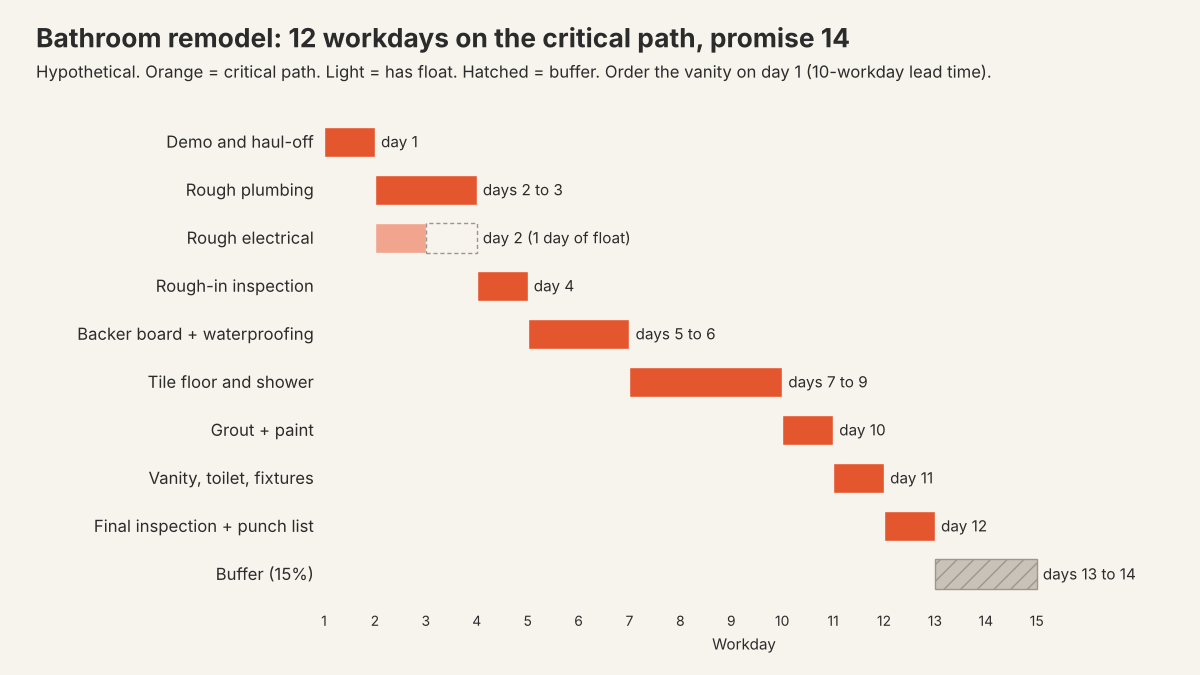
The critical path runs demo, rough plumbing, inspection, waterproofing, tile, grout and paint, fixtures, final: 1 + 2 + 1 + 2 + 3 + 1 + 1 + 1 = 12 workdays. Rough electrical takes one day while plumbing takes two, so it has a day of float.
Buffer: 12 × 15% = 1.8, rounded up to 2 days. You promise 14 workdays, a little under three weeks at five days a week. The vanity installs on day 11 and takes 10 workdays to arrive, so it gets ordered on day 1 at the latest. Better: order it when the contract is signed.
Why bother with the buffer? Say a missed inspection leaves your crew idle for a day. At a $35 loaded labor cost (an assumption), two people for 8 hours is 2 × 8 × $35 = $560 you didn't price. Without buffer, that day also pushes the next job. With it, you finish when you said you would.
5. Lead times, inspections and the customer's picks
The tasks that wreck small-job schedules usually aren't the work. They're the waiting:
- Special-order materials. Get lead times in writing from the supplier and put the order date on the schedule.
- Inspections. Book the day you know the rough-in date. Ask what the inspector needs to see so you pass the first time.
- Customer selections. Tile, fixtures, paint colors. Put a "selections due" date on the schedule and in the estimate. Late picks with an allowance cost you crew days.
- Subs. Confirm dates a week out and again the day before.
6. What to share with the customer
Give the customer the start date, the main phases and a finish window, not every task. "Two and a half to three weeks, starting the 8th" is something you can hit. "Done on the 23rd" is a promise the inspector gets to break.
Tell them what moves the dates: late selections, change orders, hidden damage, weather on exterior work. Then when it happens, it's the thing you already warned them about, not an excuse. Write the change and its days into a change order, not just its dollars.
7. Tie the schedule to your billing
Your schedule tells you when the money should come in. Put the invoice dates on it:
- Deposit at signing, before you order long-lead materials.
- Progress payments at milestones the customer can see, like rough-in passed or tile done. See construction draw schedule and progress billing.
- Final payment after the punch list. See construction project closeout.
If a milestone slips, the payment slips with it. That's the cash flow reason to protect the critical path.
8. Keep it updated
A schedule from day one is out of date by day three. Every Friday, look two weeks ahead: what's starting, what has to be ordered, who needs a call. Update the finish date when something moves on the critical path, and tell the customer the same day.
In WinPal you can manage your jobs and schedule: see today's jobs and keep track of what's done, next to the estimate and invoices for the same job.
Common construction schedule questions
What is the critical path in a construction schedule?
It's the longest chain of tasks that each depend on the one before. Its total length is the shortest time the job can take. Any delay on that chain moves your finish date. Tasks off the chain have float, so they can slip a little without changing the end date.
What should a construction schedule include?
Every task from the estimate, its duration, what it waits on, sub visits, inspections, material order dates for long-lead items, customer selection deadlines, a buffer and real calendar dates. Add invoice milestones so the schedule doubles as your billing plan.
Do I need scheduling software for a small job?
No. A spreadsheet or a simple list with dates works for a bathroom or kitchen. What matters is that durations come from your estimate hours, dependencies are marked, and you update it weekly. Software helps when you run several jobs and crews at once.
How much buffer should I add to a construction schedule?
There's no standard number. Base it on what usually goes wrong on your jobs: inspections, deliveries, hidden damage, weather. The example above uses 15% of the critical path, rounded up to whole days, as an assumption. Track how late your last few jobs ran and adjust.
How do I turn labor hours into a schedule?
Divide each task's labor hours by the crew hours you work per day, then round up. A 48-hour tile job with two people working 8-hour days is 48 ÷ 16 = 3 days. Add cure and dry times on top; they use calendar days even when nobody is working.
What to do on your next job
Open the estimate, copy the tasks into a list, convert hours to workdays, mark what waits on what, and add lead times and inspections. Find the longest chain, add your buffer, then put dates and invoice milestones on it before you give the customer a finish window. Need a clean estimate to start from? Use the construction estimate template. Doing seasonal side work this winter? See how much to charge for Christmas light installation.
Already sent the estimate? Upload it to the estimate checker and see if it's priced too low before the schedule depends on it.