Estimate Terms and Conditions: 10 Lines Every Estimate Needs
The short rules under your price decide what the customer can argue about. Here are the 10 terms to put on every estimate, disclaimer wording, and what a validity line is worth.

Estimate terms and conditions are the short rules printed under your price: how long the price is good for, what's included and excluded, how changes get handled, the deposit and payment schedule, and what happens with hidden conditions. They're what turn a number into a deal you can hold the customer to. Ten lines cover most residential jobs, and the price validity line alone can save your margin.
Re-priced total = new cost ÷ (1 − margin), once the estimate's validity period has passed.
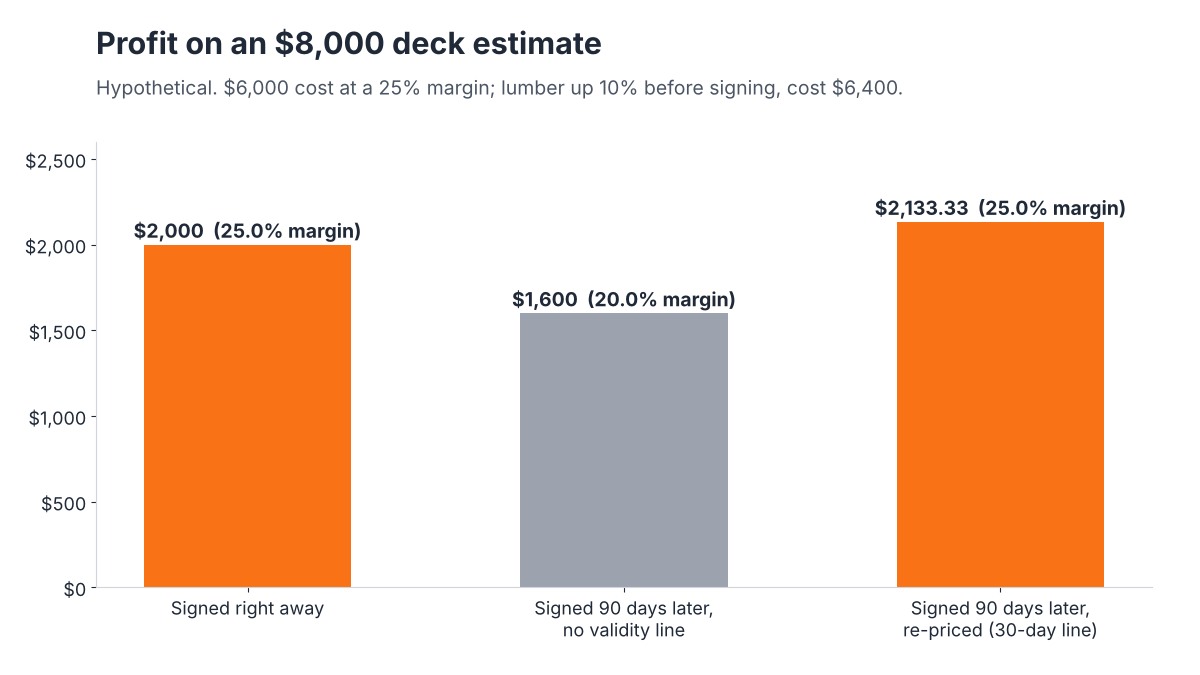
Hypothetical $8,000 deck at a 25% margin: the customer signs 90 days later after lumber goes up 10%. Without a validity line your margin drops to 20%. With one, you re-price to $8,533.33. Worked below.
An estimate without terms invites "I thought that was included" and "you said $8,000 in August." Terms don't make customers nicer. They make the conversation shorter.
Scope: US residential trade and remodeling estimates. Dollar figures are hypothetical. This isn't legal advice; contract rules vary by state, so have a local lawyer read your final wording. Related: quote vs estimate, contractor payment terms, construction scope of work.
1. What are estimate terms and conditions?
They're the conditions attached to your price. The price says what the job costs. The terms say under which assumptions, for how long, and what changes it.
An "estimate disclaimer" is usually one of those terms: the line that says the price is based on what you could see, and that hidden problems or customer changes will be priced separately. Quote terms and conditions are the same idea on a fixed-price quote. Whether you call it an estimate or a quote matters too; see quote vs estimate.
2. The 10 terms to put on every estimate
| Term | What to write | What it prevents |
|---|---|---|
| 1. Price validity | "This estimate is valid for 30 days from the date above." | Signing at last season's material prices |
| 2. Scope | What's included, by task or area, with quantities | "I thought that was included" |
| 3. Exclusions | What's not included, in plain words | Free extra work |
| 4. Hidden conditions | Price is based on visible conditions; hidden damage is priced separately | Eating rot, bad wiring, old repairs |
| 5. Allowances | Each allowance amount, what it covers, how overages are billed | Paying for the customer's upgrade |
| 6. Changes | Changes are priced and signed in writing before the work | Verbal "while you're here" jobs |
| 7. Deposit and payments | Deposit, milestone payments, final payment, due dates, how to pay | Floating the job on your card |
| 8. Permits and access | Who pulls permits, working hours, access, water and power | Lost crew days |
| 9. Materials and substitutions | Equal substitutes if a product is unavailable, with notice | Delays over a discontinued item |
| 10. Acceptance | Signature and date lines; signing accepts the price and these terms | "I never agreed to that" |
Add cleanup and disposal, warranty and cancellation lines where they apply (sections 5 and 6). Keep the whole thing to one page. Nobody reads page four.
3. Worked example: what a validity line is worth
Hypothetical deck. Materials cost $4,000, labor and everything else $2,000. Total cost $6,000. At a 25% margin: $6,000 ÷ (1 − 0.25) = $8,000. Profit $2,000.
The customer sits on it for 90 days. Lumber goes up 10% in that time, so materials now cost $4,400 and the job costs $6,400.
| Scenario | Price | Cost | Profit | Margin |
|---|---|---|---|---|
| Signed the week you sent it | $8,000 | $6,000 | $2,000 | 25.0% |
| Signed 90 days later, no validity line | $8,000 | $6,400 | $1,600 | 20.0% |
| Signed 90 days later, re-priced under a 30-day line | $8,533.33 | $6,400 | $2,133.33 | 25.0% |
Re-pricing doesn't mean gouging. Show the customer the new material quote and the same margin. Most people get it. The ones who don't would have argued about something else.
4. Estimate disclaimer examples
Short, plain, specific. Sample wording to adapt, not legal language:
- Visible conditions: "This estimate is based on conditions we could see at the site visit. Damage or defects found after work starts, such as rot, mold, or wiring or plumbing that isn't to code, will be priced as a change before we fix them."
- Estimate, not a final bill: "This is an estimate. The final invoice may differ for approved changes, allowance differences and hidden conditions. We'll tell you before any change is made."
- Quantities: "Quantities are measured at the site visit. If actual quantities differ by more than 5%, the price will be adjusted at the unit rates shown."
- Customer-supplied materials: "We don't warranty materials supplied by the customer. Extra trips or labor caused by wrong or damaged customer materials are billed at our standard rate."
- Validity: "Prices are valid for 30 days. After that, we'll confirm current material prices before scheduling."
A disclaimer doesn't let you skip a good scope. If the estimate says "remodel bathroom" and nothing else, no disclaimer saves you. Write the scope first; construction scope of work shows how.
5. Deposit, payment and cancellation terms (check your state)
Payment terms are where state rules bite. California is the strict example: its home improvement contract law requires the notice "THE DOWNPAYMENT MAY NOT EXCEED $1,000 OR 10 PERCENT OF THE CONTRACT PRICE, WHICHEVER IS LESS" (Cal. Bus. & Prof. Code § 7159). On the $8,000 deck that's an $800 cap. The same section requires change orders to be in writing and signed before the work.
Selling at the customer's home? The FTC's Cooling-Off Rule covers door-to-door sales of $25 or more made at the buyer's residence, with exceptions (16 CFR 429.0). Where it applies, the contract has to tell the buyer: "You, the buyer, may cancel this transaction at any time prior to midnight of the third business day after the date of this transaction" and come with a notice of cancellation form (16 CFR 429.1). Many states add their own rules on top.
Deposit sizes, milestone schedules and due dates are covered in contractor payment terms. Whether to charge for the estimate visit itself is in do contractors charge for estimates.
6. Warranty and cleanup lines
- Warranty: say what you cover, for how long, and what you don't (customer damage, normal wear, customer-supplied materials). Manufacturer warranties pass to the customer. Don't promise more than you'd honor on a rainy Saturday.
- Cleanup and disposal: "Daily broom clean; debris hauled away at completion." Or say it's excluded. Forgot to include cleanup? Your margin noticed.
7. Where to put the terms so customers read them
- Key terms on the same page as the price: validity, deposit, payment schedule, exclusions.
- Full terms right under or on the next page, numbered, one line each.
- Signature and date at the end, with a line that signing accepts the price and the terms.
- Walk through the top three out loud when you present it. Thirty seconds now saves a phone call later.
- Use the same terms every time. Save them once and paste them into every estimate.
Allowances need their own rules for overages and credits; the details are in construction allowance. Itemizing the scope above the terms is covered in itemized quote.
In WinPal you can build detailed estimates from a photo and a voice note, then check the estimate and send it to your client.
Common estimate terms and conditions questions
What should be in the terms and conditions of an estimate?
At minimum: how long the price is valid, what's included and excluded, how hidden conditions and changes are handled, allowances, the deposit and payment schedule, permits and access, material substitutions, and a signature line. Add warranty, cleanup and cancellation terms where they apply, and check your state's contract rules.
How long should an estimate be valid?
Thirty days is a common choice for residential work, and shorter makes sense when material prices are moving. Pick a period you can live with, print it next to the price, and re-check material costs before you schedule a job signed after it runs out.
What is an estimate disclaimer?
It's a short statement on the estimate that limits what the price covers: usually that the price is based on visible conditions, that hidden damage and customer changes will be priced separately, and that the final invoice can differ. It works alongside a clear scope, not instead of one.
Can you change the price after the customer signs?
Only the way your terms allow: a signed change order, an allowance difference, or a hidden condition your disclaimer covers. Everything else in the signed price stands. That's why the terms matter more than the total. Write the rules down before you need them.
Should terms and conditions go on invoices too?
Yes, the payment parts: due date, how to pay, and late fees if your contract and state allow them. The invoice should match the terms the customer signed on the estimate, so there's nothing new to argue about at the end.
What to do on your next estimate
Write your ten lines once, starting with price validity, exclusions and hidden conditions. Put the key ones next to the price, the rest underneath, and a signature line at the end. Need a starting point? Try the handyman estimate template or the construction estimate template.
Already sent one? Upload it to the estimate checker and see if it's priced too low.