Do Contractors Charge for Estimates? When to Charge and How Much
What a free estimate really costs you per job you win, when charging makes sense, how to set the fee and how to tell the customer.
Some contractors charge for estimates and many don't. Many residential pros give free estimates on routine jobs and charge when the estimate itself is real work: design, plans, long drives, diagnosis, or a customer who's clearly price shopping. The deciding number is what a free estimate costs you per job you actually win.
Cost of free estimates per won job = (hours per estimate × your hourly rate) ÷ your close rate.
Hypothetical: 2.5 hours at $75 an hour is $187.50 a visit. Win 1 in 4 and each job carries $750 of unpaid estimating. Worked below.
That $750 doesn't disappear because the estimate was "free." It sits in your overhead, and either your prices cover it or your profit does.
Scope: US contractors and home-service pros doing residential work. All dollar figures are hypothetical. Not sure whether you're sending an estimate or a firm price? Start with quote vs estimate.
1. Do contractors charge for estimates?
Yes, some do, and it depends on the job more than the trade. A rough split:
- Usually free: standard jobs you can price in one visit. A fence, a roof replacement, a water heater swap, a room of paint.
- Often charged: estimates that need drawings, measurements across several visits, material research or a design meeting. Kitchen and bath remodels, additions, custom work.
- Usually charged, under another name: service calls. When a plumber or HVAC tech has to find the problem before pricing the fix, that's a diagnostic or service call fee, not an estimate fee. The pricing side is in the plumbing flat rate pricing guide.
The Contractors Association puts the main reason plainly: "Charging for estimates is a way of screening prospects for their seriousness." (Contractors Association, Charging for Estimates.)
2. What a free estimate really costs you
Count the whole visit, not just the time in the customer's kitchen. Hypothetical remodeler:
- 40 minutes of driving, there and back
- 50 minutes on site: walk the job, measure, answer questions
- 60 minutes at night writing and sending the estimate
That's 150 minutes, or 2.5 hours. Value your time at $75 an hour (use your own number from the hourly rate calculator) and each visit costs $187.50.
Now the close rate. If 1 in 4 estimates turns into a job (25%), every won job has to pay for four visits: $187.50 ÷ 0.25 = $750. Five estimates a week is 12.5 hours, or $937.50 of your time, before anyone signs anything.
If your average job is $3,000, $750 of estimating per won job is a quarter of the price. That's why it belongs in your overhead, and why the price you send needs to carry it. The shared formula does that: price = cost ÷ (1 − margin), with overhead inside the cost.
3. Three ways to handle it, side by side
Same hypothetical remodeler, same $75 hour, four estimate visits:
| Approach | Hours per visit | Cost per visit | Jobs won from 4 visits | Fees kept | Unpaid estimating per won job |
|---|---|---|---|---|---|
| Free estimate, written at night | 2.5 | $187.50 | 1 | $0 | $750.00 |
| Free estimate, written on site | 1.75 | $131.25 | 1 | $0 | $525.00 |
| $150 fee, credited if hired | 2.5 | $187.50 | 2 | $300 | $225.00 |
How the rows work:
- Written on site: writing takes 15 minutes in the driveway instead of 60 at night. 1.75 hours × $75 = $131.25, and $131.25 ÷ 0.25 = $525.
- $150 fee: four visits cost $750 of time. Assume people willing to pay a fee are more serious and half of them hire you (a 50% close rate, hypothetical). The two who hire you get their $150 back as a credit on the job. The two who don't keep paying it, so you keep $300. $750 − $300 = $450, spread over 2 jobs = $225 each.
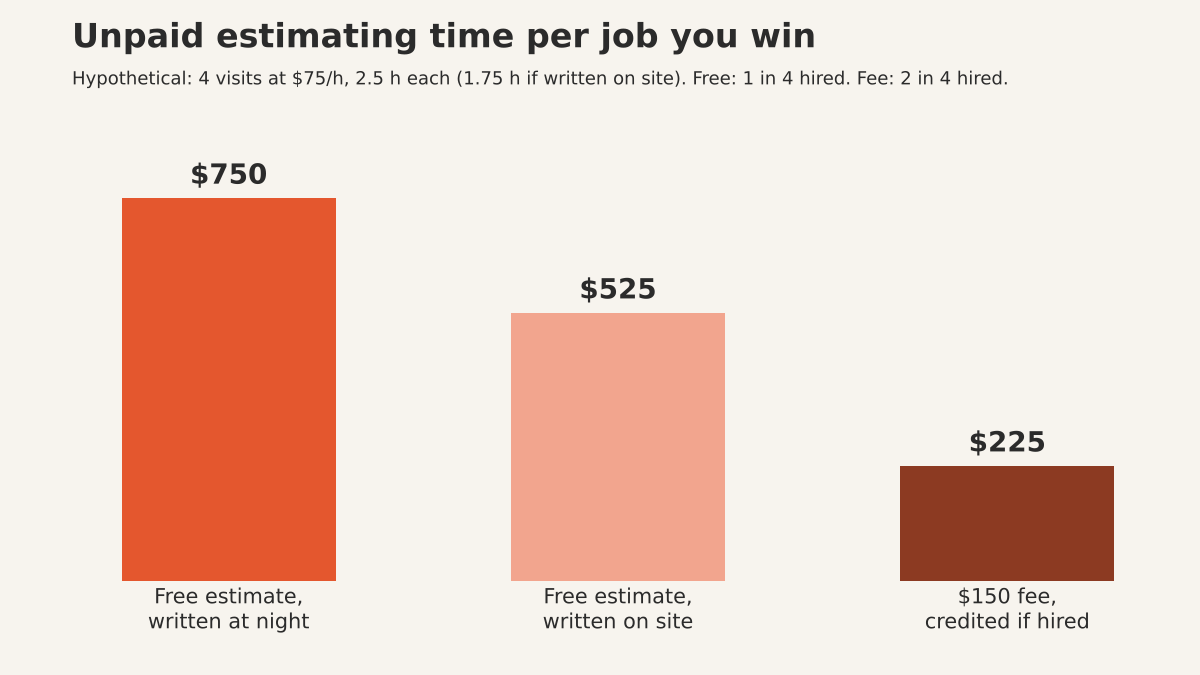
The 50% close rate is the assumption that matters most in the third row. If a fee scares off good customers too, the math changes. Try it on a few jobs before you put it on every one.
4. When charging for estimates makes sense
Charge when the estimate is a deliverable the customer could take to someone else:
- Design or plans are involved. Layouts, material selections, drawings. That's work, and other contractors can bid off it.
- It takes more than one visit. Second measure, a meeting with the designer, a return trip to look behind the drywall.
- The drive is long. An hour each way doubles the cost of the visit.
- Your calendar is full. If you're booked six weeks out, a free estimate slot is worth more than the visit costs.
- You keep losing to the lowest bid. If people are collecting three prices and picking the cheapest, a fee sorts them out early.
- You have to diagnose before you can price. That's a service call fee, and most customers already expect it.
5. When to keep estimates free
Free estimates still win plenty of work. Keep them free when:
- You can price the job in one short visit, or from photos.
- Your local competitors all advertise free estimates and you're not booked out.
- You're new and need the at-bats.
- The lead came from a referral or a repeat customer. They're already serious.
- It's a small job where a fee would be a big share of the price.
A middle path works for a lot of shops: free ballpark by phone or from photos, free site visit for standard work, paid estimate for anything with design or plans.
6. How much to charge for an estimate
Price the fee the same way you price a job: from your cost.
- Add up the visit: drive, time on site, time to write it. In the example, 2.5 hours.
- Multiply by your hourly rate. 2.5 × $75 = $187.50. That's a fee that pays for the visit in full.
- Decide how much to recover. A round number under the full cost, like $150, is easier to say out loud and still covers most of it.
- Decide on the credit. The Contractors Association suggests you "credit the cost of the estimate into the cost of the project for prospects who become clients." Crediting makes the fee an easy yes for serious customers.
- Charge more for design work. If the estimate includes drawings or a full material spec, price those hours separately or as a design agreement.
7. How to tell customers about the fee
Say it before you book the visit, not at the door. Something like:
"For a job this size I do a detailed estimate with measurements and a full material list. That's $150, and if you hire us it comes off the final invoice."
Then put it in writing: in the booking text or email, and as its own line on the estimate. Take the payment when you book or at the visit, so you're not chasing $150 later. Put the credit on the job invoice as a line too, so the customer sees it come off.
8. Cut what free estimates cost you
If you'd rather keep estimates free, shrink the hours and raise the close rate instead:
- Qualify on the phone. Budget, timeline, who decides. Two minutes here saves a wasted 2.5-hour visit.
- Ask for photos first. Plenty of small jobs can get a range without a visit.
- Give a ballpark range early. If a $12,000 kitchen refresh scares them, better to know before the drive.
- Write it in the driveway. In WinPal you can take a photo of the job, describe it in a voice note and get a detailed estimate to check and send before you pull out.
- Follow up once, on a set day. An estimate nobody follows up on has a close rate of whatever happens by accident.
- Use a template for repeat job types, like the handyman estimate template.
Every hour you cut and every point of close rate you add lowers the number in section 2. Want the customer choosing between your prices instead of between you and the next contractor? See good better best pricing. Pricing the job itself? The process is in how to price handyman jobs and how to estimate construction costs.
Common questions about charging for estimates
Do contractors charge for estimates?
Some do. Many residential contractors give free estimates on standard jobs they can price in one visit, and charge for estimates that involve design, plans, several visits or long drives. Service trades usually charge a diagnostic or service call fee when they have to find the problem first. Many contractors credit the fee toward the job if you hire them.
How much do contractors charge for estimates?
There's no standard fee. A sensible fee covers the visit: drive time, time on site and time to write the estimate, multiplied by your hourly rate. In this article's hypothetical, 2.5 hours at $75 is $187.50, and a $150 fee credited toward the job recovers most of it. Design work is priced separately.
Do roofers charge for estimates?
Roof replacement estimates are commonly free, because a roof can usually be measured and priced in one visit. Repairs that need investigation, inspections for insurance claims and reports a homeowner can shop around are more likely to carry a fee. Check what roofers in your area advertise before you decide.
Do plumbers charge for estimates?
For installs and replacements a plumber can price on sight, like a water heater, estimates are often free. For leaks, clogs and anything they have to diagnose, plumbers usually charge a service call or diagnostic fee, and many credit it toward the repair. That's a fee for the visit, not for the estimate itself.
Should a handyman charge for estimates?
Usually not for small, common jobs. Price those by phone, from photos or on the spot. Charge when a job needs a second visit, research or a long drive, or when you're booked weeks out. A trip charge on the job invoice is another way to cover the drive; mention it before the visit.
What to do on your next estimate request
Write down how long your last five estimates really took, drive included, and how many turned into jobs. Run the section 2 math. If the number per won job is bigger than you like, qualify harder, write on site, or start charging for the big ones.
Already sent one? Upload it to the estimate checker and see if it's priced too low.