Construction Project Closeout: Checklist and How to Get Paid
The checklist, the closeout documents and the final invoice, plus a hypothetical $48,000 remodel where three-quarters of the profit waits on closeout.
Construction project closeout is the last phase of a job: finish the punch list, pass final inspection, hand over warranties and documents, settle change orders, send the final invoice and collect the last payment or retainage. On a small job it can all happen in the last visit, if you planned it from day one.
Closeout is where the profit is still waiting.
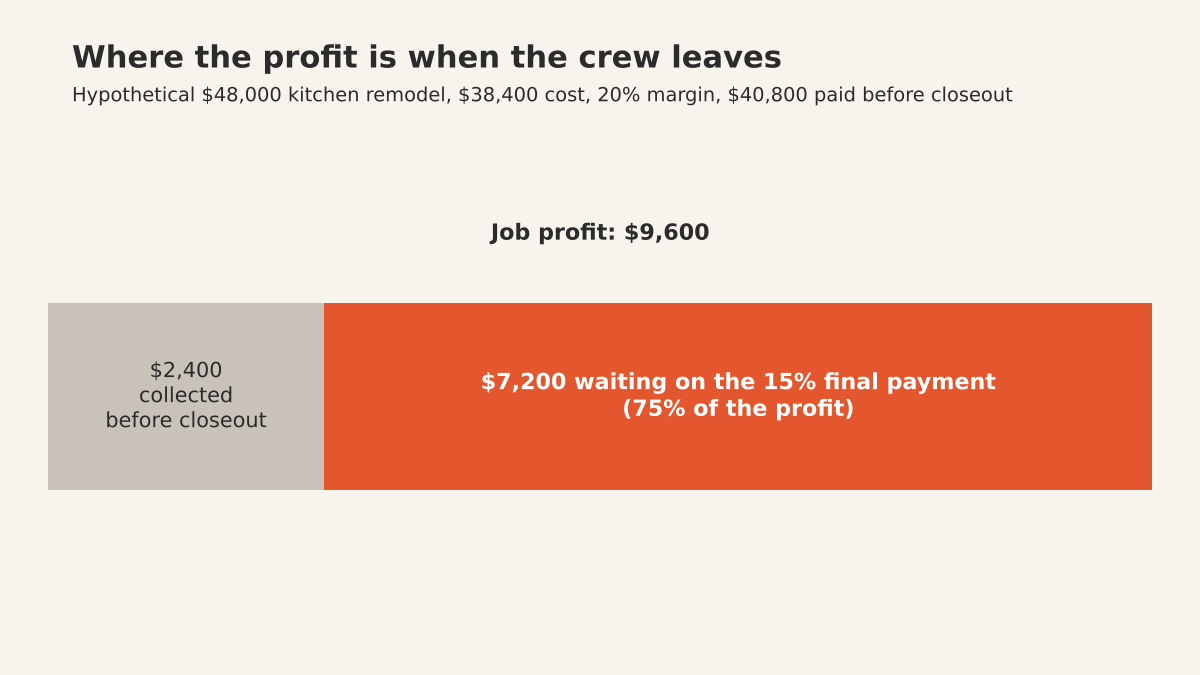
Hypothetical $48,000 kitchen remodel priced at a 20% margin: $9,600 of profit. With a 15% final payment, $7,200 is still unpaid at closeout. That's three-quarters of the job's profit. Worked below.
Why it matters: the crew is already on the next job, the customer is living in a finished kitchen, and nobody feels urgent about the paperwork except you. A sloppy closeout is how the last payment slides 60 days.
Scope: US residential and light commercial jobs run by a small GC, remodeler or trade contractor. Dollar figures are hypothetical. Related: punch list, retainage, contractor payment terms. This isn't legal advice.
1. What is construction project closeout?
Procore puts it simply: "Closeout is the final phase of construction before a project is handed over to the owner." It adds that closeout "is also the time to settle all outstanding bills, change orders, or any other additional costs" (Procore).
For a small contractor, that means three things: the work is done and accepted, the customer has everything they need to live with it, and you've been paid for the whole job.
2. Start closeout at the start of the job
The easiest closeout is one you set up in the contract. Before the first day of work:
- Define "complete" in writing: final inspection passed and punch list items signed off.
- Tie the final payment to that, not to "customer satisfaction." See contractor payment terms.
- Say how disputed items are handled: the customer holds back only for the open item, not the whole final payment (section 6).
- Keep a folder per job from day one: permits, change orders, product spec sheets, warranty cards, photos.
If the folder fills up as you go, closeout is an afternoon. If it doesn't, it's a scavenger hunt through your truck.
3. Construction closeout checklist
| Item | Who | Why it matters for getting paid |
|---|---|---|
| Punch list walked, fixed and signed off | You and the customer | Removes the main reason to hold the final payment |
| Final inspection passed, permit closed | You and the inspector | Many contracts define completion this way |
| Every change order signed and priced | You and the customer | Unsigned extras are the hardest money to collect |
| Subs and suppliers paid, lien waivers collected | You | Customers and lenders often ask before paying |
| Warranty letter (your labor) and manufacturer warranties | You | Shows what's covered, and for how long |
| Manuals, spec sheets, paint colors, model numbers | You | Fewer callbacks asking "what was that tile?" |
| Photos of in-wall work before close-up | You | Backs up your work if questions come up later |
| Keys, codes, remotes, leftover materials handed over | You | The customer feels the job is done |
| Final cleanup | Your crew or a cleaner | First impression of the finished job |
| Final invoice sent the same day | You | Starts the payment clock |
| Retainage release requested, if any | You | Retention doesn't release itself |
| Customer sign-off on completion | The customer | Your proof the job was accepted |
The punch list is its own process; how to run it is in punch list.
4. Closeout documents to hand over
On a residential job, a closeout package can be one PDF or a folder on the counter. It should hold:
- The signed contract and every signed change order.
- The permit card and final inspection sign-off.
- Your workmanship warranty, with dates and what it covers.
- Manufacturer warranties and registration info for equipment and fixtures.
- Care and maintenance instructions.
- Product list: brands, model numbers, colors, finish names.
- Photos of the work, including what's now behind drywall.
- Lien waivers, if your contract or the customer's lender requires them.
Commercial jobs add more (as-built drawings, O&M manuals, attic stock), usually spelled out in the specs. Read that section before you bid, not at the end.
5. Worked example: what's at stake at closeout
Hypothetical kitchen remodel:
| Line | Amount |
|---|---|
| Total job cost | $38,400 |
| Price at 20% margin: $38,400 ÷ 0.80 | $48,000 |
| Profit | $9,600 |
| Payments before closeout (deposit and progress, 85%) | $40,800 |
| Final payment at completion (15%) | $7,200 |
By the time the crew leaves, you've spent the whole $38,400 and collected $40,800. The $7,200 still out is 75% of the job's profit. Until closeout is done, you've done the work for $2,400.
Change orders make it bigger. Approved extras that you planned to "put on the final bill" are also waiting on closeout. Bill them as you go if your contract allows; see construction change orders.
6. Send the final invoice and release the retainage
Send the final invoice the day the punch list is signed off, not at the end of the month. It should show the contract price, every change order, every payment received, and the balance due. Add any retainage being released as its own line.
If the owner held retention, state law may set the clock. In California, for example, the owner "shall, within 45 days after completion of the work of improvement, pay the retention to the contractor," and in a good faith dispute may withhold "an amount not in excess of 150 percent of the disputed amount" (Cal. Civ. Code § 8812). Other states differ; the basics are in retainage.
You can borrow the same idea for your own contracts. In the example, if the customer disputes a $400 cabinet door adjustment, they hold back $600, and $6,600 gets paid now. Much better than waiting on all $7,200 over one door.
With WinPal you can invoice from your phone and let clients pay online, so the final invoice can go out from the driveway after the walk-through.
7. When the customer stalls
- Ask what's open, in writing. A vague "not happy yet" becomes a list you can fix.
- Fix the list, get it signed, and resend the invoice the same day.
- Follow up on a schedule: due date, three days after, a week after.
- Know your options before you need them. Lien deadlines are short and vary by state. See can a contractor sue for non-payment, and talk to a lawyer early.
8. After closeout: close the job in your books too
Once you're paid, take ten minutes on the numbers: estimated cost vs actual, hours vs plan, which change orders you almost forgot. That's how the next estimate gets better. The method is in construction job costing.
Then put the warranty end date in your calendar, and ask the happy customer for a review or a referral while the kitchen still looks new.
Common construction closeout questions
What is project closeout in construction?
It's the final phase of a job: the work is finished and accepted, the customer gets the warranties and documents, outstanding bills and change orders are settled, and the contractor sends the final invoice and collects the last payment or retainage. It starts with the punch list and ends when you're paid.
What documents are needed for construction closeout?
On a residential job: the signed contract and change orders, permit and final inspection sign-off, your workmanship warranty, manufacturer warranties, care instructions, a product list with model numbers and colors, photos of hidden work, and lien waivers if required. Commercial specs usually list more, such as as-builts and O&M manuals.
What is the difference between a punch list and closeout?
The punch list is one step of closeout: the list of small items to fix before the job is accepted. Closeout is everything around it, from final inspection and handover documents to the final invoice, retainage release and payment. A finished punch list is usually what triggers the final payment.
When should you send the final invoice?
The same day the punch list is signed off and the final inspection has passed. Waiting until the end of the month adds weeks to when you get paid. Show the contract price, change orders, payments received, retainage released and the balance due.
How long does construction closeout take?
It depends on the job and on how ready you are. If documents, change orders and photos were filed as you went, a small residential job can close out in the last visit. If you start collecting them at the end, expect it to drag, and the last payment with it.
What to do on your next job
Write "complete" into the contract, start a closeout folder on day one, walk the punch list with the customer, hand over the package, and send the final invoice before you leave. Then do the job costing while it's fresh.
Plumbing service work too? See how to sell plumbing services.
Ready to send it? Invoice from your phone and let clients pay online with WinPal.