Construction Billing: 5 Methods and How to Pick One per Job
The five construction billing methods, how to pick one per job, how to set the billing schedule, and what every construction invoice should show.

Construction billing is how and when you charge for a job: the billing method in the contract (lump sum, cost plus, time and materials, unit price or guaranteed maximum price), the schedule you bill on, and the invoices you send. Pick the method per job, based on how well you know the scope.
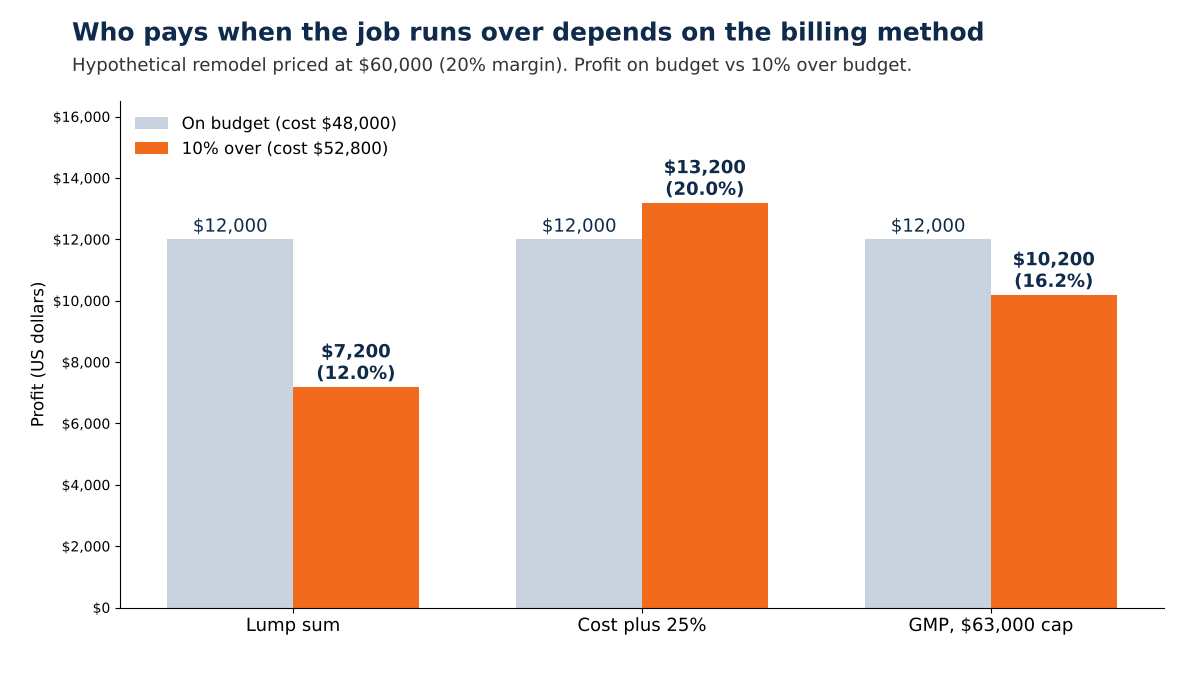
The method decides who pays when a job runs over.
Hypothetical $60,000 remodel, $48,000 of cost at a 20% margin. If costs run 10% over and it's not a change order, lump sum leaves you $7,200 of profit; cost plus leaves you $13,200. Worked below.
Why it matters: the billing method is decided once, at signing, and you live with it for the whole job. Pick the wrong one and you either eat the surprises or bury the customer in paperwork.
Scope: US residential and light commercial jobs run by small GCs, remodelers and trade contractors. Dollar figures are hypothetical. Related: progress billing, types of construction contracts, schedule of values. This isn't legal advice.
1. What is construction billing?
It's the money side of the contract. As Procore puts it, "Construction billing always refers back to the contract terms that dictate how contractors will charge" (Procore).
Two decisions make up your billing:
- The method: what you charge for (a fixed price, your costs plus a fee, your hours and materials, units of work).
- The schedule: when you send invoices (deposit and final, milestones, monthly progress, weekly time sheets).
The contract type and the billing method usually match. The contract side, with who carries the risk, is in types of construction contracts. This page is about getting the invoices right.
2. The five construction billing methods
| Method | You bill | Best for | Watch out for |
|---|---|---|---|
| Lump sum (fixed price) | An agreed total, split into payments | Clear scope you've done many times | Anything you missed comes out of your profit |
| Cost plus | Your actual costs plus a fee (percent or fixed) | Unclear scope, owner wants open books | Heavy paperwork: every receipt and time sheet |
| Time and materials (T&M) | Hours at an agreed rate plus materials | Small jobs, repairs, unknown conditions | Customers fear an open-ended bill; add a not-to-exceed |
| Unit price | A price per unit times units installed | Repeatable work: square feet, linear feet, fixtures | Quantities must be measured and agreed |
| Guaranteed maximum price (GMP) | Costs plus fee, up to a cap | Owners who want open books and a ceiling | You pay anything over the cap |
On time and materials, Procore notes the contractor builds "profit margins in the hourly prices quoted to the owner". So your T&M rate isn't your wage. It's your loaded cost plus overhead, divided by one minus your margin. The hourly rate calculator does that math.
On GMP, Procore points out that "GMP billing allows the customer to keep the savings." You take the overrun risk of a fixed price and give up the upside. Price the cap with that in mind.
3. Worked example: the same job, three ways
Hypothetical remodel. Estimated cost $48,000. Target margin 20%.
- Lump sum price: $48,000 ÷ (1 − 0.20) = $60,000.
- Cost plus fee that earns the same 20% margin: 0.20 ÷ 0.80 = 25% of cost. $48,000 × 1.25 = $60,000.
- GMP: cost plus the 25% fee, capped at $63,000 (a cap the contractor and owner agreed).
Now the job runs 10% over: hidden conditions push cost to $52,800, and the contract doesn't let you change-order them.
| Method | Billed, on budget | Profit | Billed, 10% over | Profit |
|---|---|---|---|---|
| Lump sum | $60,000 | $12,000 (20%) | $60,000 | $7,200 (12.0%) |
| Cost plus 25% | $60,000 | $12,000 (20%) | $66,000 | $13,200 (20.0%) |
| GMP $63,000 | $60,000 | $12,000 (20%) | $63,000 | $10,200 (16.2%) |
One trap worth a second look: a 20% fee is not a 20% margin. $48,000 × 1.20 = $57,600, profit $9,600, which is a 16.7% margin. Same markup vs margin mix-up as anywhere else; see contractor markup.
4. How to pick a billing method per job
- You've built it ten times and can see everything: lump sum. You keep the upside of working efficiently.
- You can't see inside the walls, or the scope will move: T&M with a not-to-exceed, or cost plus. Either way, agree on the rate or fee first.
- The work is a quantity: unit price (per square foot of tile, per linear foot of fence, per fixture). Agree how units get measured.
- The owner wants open books and a ceiling: GMP, with a cap that has room for surprises.
- A mix: fixed price for the known scope plus T&M for the unknown part (rot repair, say). Spell out which is which.
Whatever you pick, exclusions and change order terms are what protect a lump sum. See construction change orders.
5. Set the billing schedule
The method says what you charge. The schedule says when. On anything longer than a couple of weeks, don't wait for the end:
- Deposit at signing, within your state's limits. See contractor payment terms.
- Milestone or progress payments tied to work you can point at: demo done, rough-in passed, cabinets set. How to bill them is in progress billing, and how to split the price into billable lines is in schedule of values.
- Weekly or biweekly invoices on T&M and cost plus, with time sheets and receipts attached.
- Final payment tied to a written definition of complete, plus any retainage release.
Retainage is common on larger and public work. On federal contracts, for example, if progress isn't satisfactory the contracting officer "may retain a maximum of 10 percent of the amount of the payment until satisfactory progress is achieved" (FAR 52.232-5). Private contracts and state rules vary.
How those payments land against your bills week by week is in construction cash flow and construction draw schedule.
6. What every construction invoice should show
- Job name and address, invoice number and date, the billing period.
- Contract price, approved change orders and the revised contract total.
- Work completed to date (percent or units), and what's billed this time.
- Previous payments received, retainage held, and the balance due now.
- For T&M and cost plus: hours, rates, materials and the receipts behind them.
- Due date and how to pay.
Starting from scratch? The contractor invoice template has the basics. With WinPal you can invoice from your phone and let clients pay online, so a milestone invoice can go out from the site the day the milestone is done.
7. The construction billing process, start to finish
- Write the method and schedule into the contract, with rates, fees, caps and what triggers each payment.
- Break the price into billable lines before work starts.
- Track as you go: percent complete, hours, receipts, change orders.
- Bill on the schedule, not when you remember. Change orders get billed with the next invoice, not saved for the end.
- Follow up on the due date, then a few days after.
- Close out: final invoice and retainage release the day the work is accepted. See construction project closeout.
Common construction billing questions
What are the main construction billing methods?
Lump sum (a fixed price split into payments), cost plus (actual costs plus a fee), time and materials (hours at a rate plus materials), unit price (a rate per unit of work) and guaranteed maximum price (cost plus a fee, up to a cap). Many jobs mix two, such as fixed price for known work and T&M for unknowns.
What is the difference between progress billing and lump sum?
They answer different questions. Lump sum is a method: one agreed price. Progress billing is a schedule: you invoice parts of the price as work gets done. A lump sum job can be billed with a deposit and a final payment, or in progress payments. Bigger jobs should almost always use progress payments.
How do you bill time and materials?
Agree on the hourly rate and the materials markup in writing before work starts, with a not-to-exceed if the customer wants one. Invoice weekly or by phase with hours worked, the rate, materials with receipts, and the total. The rate should already include your overhead and profit, not just wages.
What fee should a cost plus contract use?
Work it out from the margin you need, not by habit. To earn a 20% margin, the fee is 0.20 ÷ 0.80 = 25% of cost. A 20% fee only gives you a 16.7% margin. Check whether overhead is billed as a cost or covered by the fee, because that changes the number.
How often should a contractor bill on a construction job?
Match the job length and your cash. Short jobs: deposit and final. Jobs over a few weeks: milestones or monthly progress billing. T&M and cost plus: weekly or biweekly. The goal is to never be far ahead of the customer's money.
What to do on your next contract
Pick the billing method from how well you know the scope, set the fee or rate from your margin, write the payment triggers into the contract, and bill on schedule. Check the math on your target margin with the profit margin calculator.
Customer asking for a line-by-line price up front? See itemized quote.
Ready to bill? Invoice from your phone and let clients pay online with WinPal.