Backcharge in Construction: What It Is and How to Push Back
A backcharge is a deduction from your pay for a cost the GC says you caused. Here's what a fair one needs, how to dispute it, and the profit math.
A backcharge (also written back charge) is money a general contractor or owner deducts from what it owes you to cover a cost it says you caused: cleanup you didn't do, damage to someone else's work, defective work it had fixed, or equipment you used. It's a contract right, not a law. If your contract allows it and the cost is real and documented, it's fair. If not, push back in writing.
What you get paid = what you billed − retainage − the backcharges you accept.
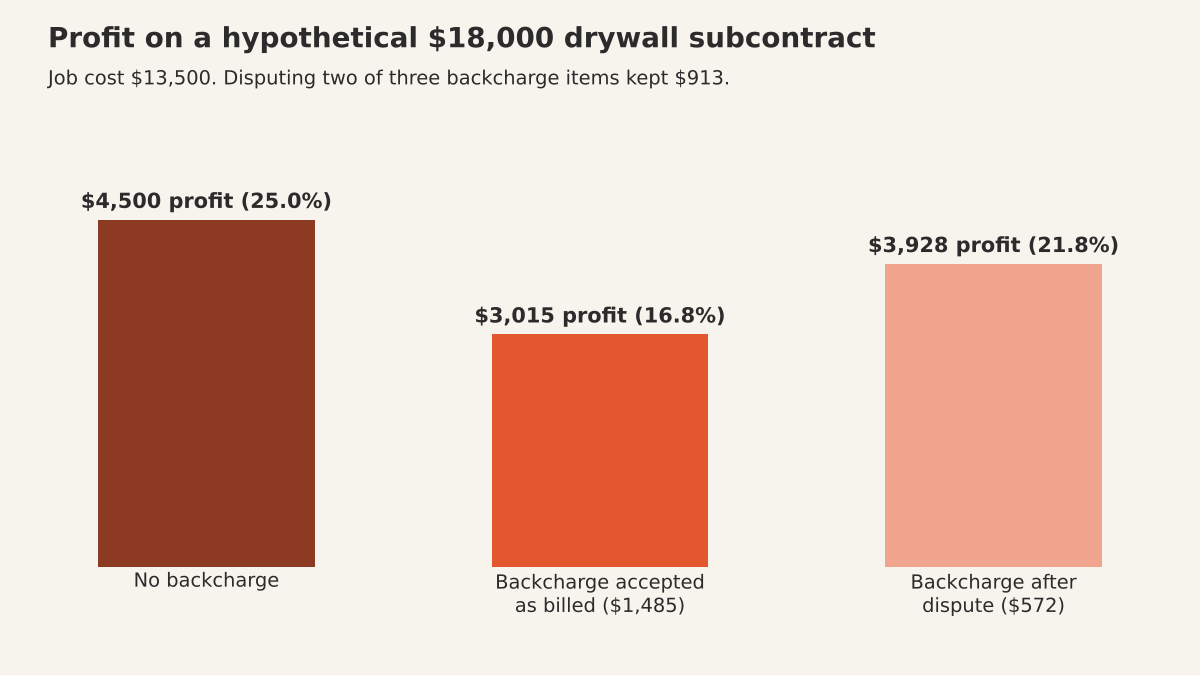
Hypothetical drywall sub on an $18,000 contract: a $1,485 backcharge accepted as billed cuts profit from $4,500 to $3,015. Disputed with photos and a daily log, it drops to $572. Worked below.
Why it matters: a backcharge comes straight out of your profit, not your costs. You already paid the crew and the supply house.
Scope: US subcontractors and small trade businesses working under a general contractor, plus contractors who backcharge their own subs. Dollar figures are hypothetical. This isn't legal advice; for a large or contested backcharge, have a construction lawyer read your contract.
1. What a backcharge is, and what it isn't
A backcharge is a deduction from your payment, usually on your next pay application or invoice. The GC says it spent money because of you, and it takes that money back from what it owes you.
The right to do that comes from the contract. Levelset puts it plainly: "Back charges are not statutory, or provided by law." Nationwide Notice says the same: "The right to back charge is a contractual right that must be established when the contract between suppliers, subcontractors, and the general contractor is signed." (Levelset, Nationwide Notice.)
So the first question on any backcharge is: what does your subcontract say? Look for a backcharge, cleanup, damage or "failure to perform" clause, any notice requirement, and any markup or fee the GC can add.
A backcharge isn't the same as these:
- Retainage: money held back on purpose until the job is done, then released. A backcharge is gone unless you dispute it. See retainage.
- A deductive change order: both sides agree to shrink the scope and the price. A backcharge is the GC's claim against you. See construction change orders.
- A setoff: a deduction for costs on a different project. Levelset notes some states limit setoffs, so check your state and your contract.
2. The most common reasons for backcharges
Between them, Levelset and Nationwide Notice list the usual suspects:
- Cleanup. Your scrap, mud buckets or packaging left on site, and the GC paid someone to haul it.
- Damage to other trades' work. A gouged door, a cracked tile, a dented duct.
- Defective or incomplete work the GC had another crew fix.
- Defective materials you supplied.
- Equipment use. Your crew used the GC's lift, scaffold or dumpster beyond what the contract covers.
- Safety and site conditions the GC had to correct after your crew.
Cleanup is the one that bites small crews most, because "clean up daily" in a subcontract means different things to different people. If the GC brings in a cleaning crew, you'll see their hours on your backcharge. What that crew charges is in the post-construction cleaning price list.
3. What a fair backcharge looks like
A backcharge you should pay has all of these:
- A clause in your contract that allows it.
- Written notice of the problem, close to when it happened, not a surprise list at the end of the job.
- A chance to fix it yourself. Your crew can usually fix a problem for less than the GC pays someone else.
- Backup for the cost: hours, rates, receipts, photos, dates.
- A markup only if the contract allows one, at the rate it states.
Federal construction contracts follow the same order. Under FAR 52.246-12, the contractor fixes rejected work first; only if it doesn't do it promptly may the Government "replace or correct the work and charge the cost to the Contractor" (FAR 52.246-12(g)). That's a federal clause, not a rule for your residential subcontract, but it's a fair model: notice, a chance to fix, then the cost.
4. Worked example: a drywall sub's $1,485 backcharge
Hypothetical. You hang and finish drywall on a remodel for $18,000. Your cost is $13,500, priced with the shared formula, price = cost ÷ (1 − margin): $13,500 ÷ (1 − 0.25) = $18,000. Profit if nothing goes wrong: $4,500.
With your last pay request, the GC sends a backcharge:
| Item | GC's charge | Your records show | Outcome |
|---|---|---|---|
| Cleanup, 8 hours at $65 | $520 | Two days without a full sweep, per your daily log | Accept |
| Dumpster pull | $450 | Subcontract says the GC provides dumpsters | Dispute |
| Door slab replaced | $380 | Dated photo: door undamaged when your crew left | Dispute |
| 10% fee on $1,350 | $135 | Contract allows 10% | Accept on the cleanup only ($52) |
| Total | $1,485 | $572 |
Accept it as billed and your profit drops to $4,500 − $1,485 = $3,015, a 16.8% margin. Dispute two items with your records and you pay $520 + $52 = $572, which leaves $3,928, a 21.8% margin. The photos and the log were worth $913.
Here's the part that stings: to earn back a $1,485 loss at a 25% margin, you need $1,485 ÷ 0.25 = $5,940 of new work. The same make-up math shows up in underbidding.
5. How to respond to a backcharge
- Read the clause before you answer. Note any deadline for disputing.
- Ask for itemized backup: who did the work, how many hours, at what rate, receipts and photos.
- Compare it to your own records: daily log, dated photos, delivery tickets, texts and emails with the super.
- Accept what's fair in writing, item by item. Paying the fair part quickly makes the rest of your dispute more believable.
- Dispute the rest in writing with the reason and your proof for each item. If the cost looks high, check it against a loaded labor rate; see labor burden.
- Offer to fix it yourself if the work isn't done yet.
- Read every lien waiver before you sign it. A waiver can give up your right to money you're still disputing. Levelset notes that if a backcharge wasn't provided for in the contract, you may be able to file a mechanics lien for the unpaid amount; lien rules vary by state, so ask a lawyer before you rely on that.
If the GC still won't pay what's owed, the options and deadlines are in can a contractor sue for non-payment.
6. How to avoid backcharges in the first place
- Write the scope with exclusions, including who cleans up, who provides dumpsters and who protects finished work. See construction scope of work.
- Take dated photos of your area when you start and when you leave each day. They cost nothing and win most damage arguments.
- Keep a daily log: crew, hours, what got done, what you found broken when you arrived.
- Ask for a notice clause so problems reach you in writing while you can still fix them. Nationwide Notice recommends a "notice required" provision for exactly this.
- Get a sign-off when you hand an area to the next trade.
- Price cleanup into the job instead of hoping nobody notices. Thirty minutes a day is cheaper than a $65-an-hour cleaning crew.
7. Backcharging your own subs
If you're the one hiring subs, the same rules protect you:
- Put a backcharge clause, a notice requirement and a fee rate in the subcontract.
- Tell the sub in writing as soon as you find the problem, with photos.
- Give them a chance to fix it before you hire someone else.
- Track the real cost: hours at a real rate, receipts, the date.
- Deduct it as its own line on their next payment, with the backup attached.
A surprise list at the end of the job starts a fight. A dated notice with a photo usually doesn't.
8. How a backcharge shows up on your invoice
Keep backcharges as separate lines, never folded into the contract total. On each invoice or pay application, show the contract amount, work completed, retainage held, accepted backcharges and the amount due. Disputed items stay listed as disputed until they're settled. How pay applications work is in progress billing, and what every invoice should carry is in how to invoice as a contractor.
If the GC directs extra work at the same time it backcharges you, price the extra work as its own change. See construction change directive.
Common backcharge questions
What is a backcharge in construction?
A backcharge is a deduction a general contractor or owner takes from a subcontractor's or supplier's payment to cover a cost it says that party caused, such as cleanup, damage, defective work or equipment use. It's a contract right, so whether it's allowed, and how, depends on what the subcontract says.
Can a GC backcharge me without notice?
It depends on your contract. Many subcontracts require written notice and a chance to fix the problem first; some don't. If yours requires notice and you didn't get it, say so in writing when you dispute the charge. Going forward, ask for a notice clause before you sign.
Can a backcharge include a markup?
Only if the contract allows one. Many subcontracts let the GC add a fee for handling the work, often stated as a percentage. Without that wording, a backcharge should be the documented cost: hours at a stated rate, receipts and nothing else. Ask for the backup either way.
What's the difference between a backcharge and a change order?
A change order is an agreed change to the scope and price, signed by both sides. A backcharge is one side's claim that the other owes it money for a cost it caused. A change order changes the contract; a backcharge is a deduction under it, and you can dispute it.
How do I dispute a backcharge?
Answer in writing, item by item, before any deadline in your contract. Ask for itemized backup, compare it to your daily log and dated photos, accept what's fair and dispute the rest with your reasons and proof. Read any lien waiver carefully before signing it while money is still in dispute.
What to do on your next job
Before you start, find the backcharge and cleanup lines in the subcontract and price cleanup in. Then take a photo of your area every day you leave it. The cheapest backcharge is the one you can prove you don't owe.
Cleaning up after other trades is its own business. Here's what cleaners put on their cleaning services list.
Want backcharges, retainage and what's still due on one invoice? In WinPal you can invoice from your phone and let clients pay online.