Underbidding: What a Low Bid Really Costs You
A low bid wins the job and eats the profit from the next one too. The make-up math on a worked deck example, the warning signs, and how to stop.
Underbidding means pricing a job below what it costs you to do it plus a fair profit. Sometimes it's on purpose, to win the job. More often it's an accident: costs that never made it onto the estimate. Either way, the customer signs your number and the difference comes out of your pocket.
Extra work needed to win back lost profit = lost profit ÷ your margin.
Hypothetical deck: bidding $9,500 instead of $12,000 gives up $2,500 of profit. At a 25% margin, you need $10,000 of extra work to earn it back. Worked below.
Why it matters: a low bid doesn't just shrink one job. It eats the profit from the next one too.
Scope: US contractors and home-service pros pricing residential and light commercial work. All dollar figures are hypothetical. If you think your estimates are low because something keeps getting left off, start with construction estimating mistakes.
1. What underbidding means
There are two kinds, and they need different fixes.
- Accidental underbidding: you meant to make 25% and the estimate was missing labor load, waste, the dumpster or the setup day. You find out when the job is done and the money isn't there.
- Deliberate underbidding: you knew the number was thin and sent it anyway, to win the job, beat a competitor, or fill a slow month.
The federal government even has a name for the deliberate kind. FAR 3.501-1 calls it buying-in: "submitting an offer below anticipated costs, expecting to- (1) Increase the contract amount after award (e.g., through unnecessary or excessively priced change orders); or (2) Receive follow-on contracts at artificially high prices to recover losses incurred on the buy-in contract." (FAR 3.501-1.)
That's a federal buying rule, not a law for your residential work. But it describes the plan behind most deliberate low bids, and why it rarely works. More on that in section 4.
2. Why contractors underbid
Almost nobody underbids because they want to work for free. It usually comes from one of these:
- Fear of losing the job. Especially when the schedule has a hole in it next month.
- Matching the lowest price the customer says they got, without knowing what that bid left out.
- No real cost numbers. If you've never compared estimated to actual, you're pricing from memory. See construction job costing.
- Pricing labor at the wage instead of the loaded cost. See labor burden.
- No overhead in the price. Truck, insurance, phone, software. See construction overhead.
- Markup used as margin. A 25% markup is a 20% margin. See contractor markup.
3. Worked example: three bids on the same deck
Hypothetical deck job. Your full cost to build it: $4,600 of materials, 88 crew hours at a $45 loaded cost ($3,960), and $440 for the permit and haul-off. That's $9,000.
Your normal price uses the shared formula, price = cost ÷ (1 − margin): $9,000 ÷ (1 − 0.25) = $12,000. The customer says another contractor quoted $10,500. Here are your three options:
| Bid | Price | Profit if on budget | Margin | Profit if the job runs 10% over |
|---|---|---|---|---|
| Your normal price | $12,000 | $3,000 | 25.0% | $2,100 |
| Match the other bid | $10,500 | $1,500 | 14.3% | $600 |
| Go lower to be sure | $9,500 | $500 | 5.3% | $400 loss |
The 10% overrun is $900 of extra cost: a rainy week, a second lumber run, a footing that needed more digging. Jobs run long. At $12,000 it's annoying. At $9,500 you paid $400 for the privilege of building the deck.
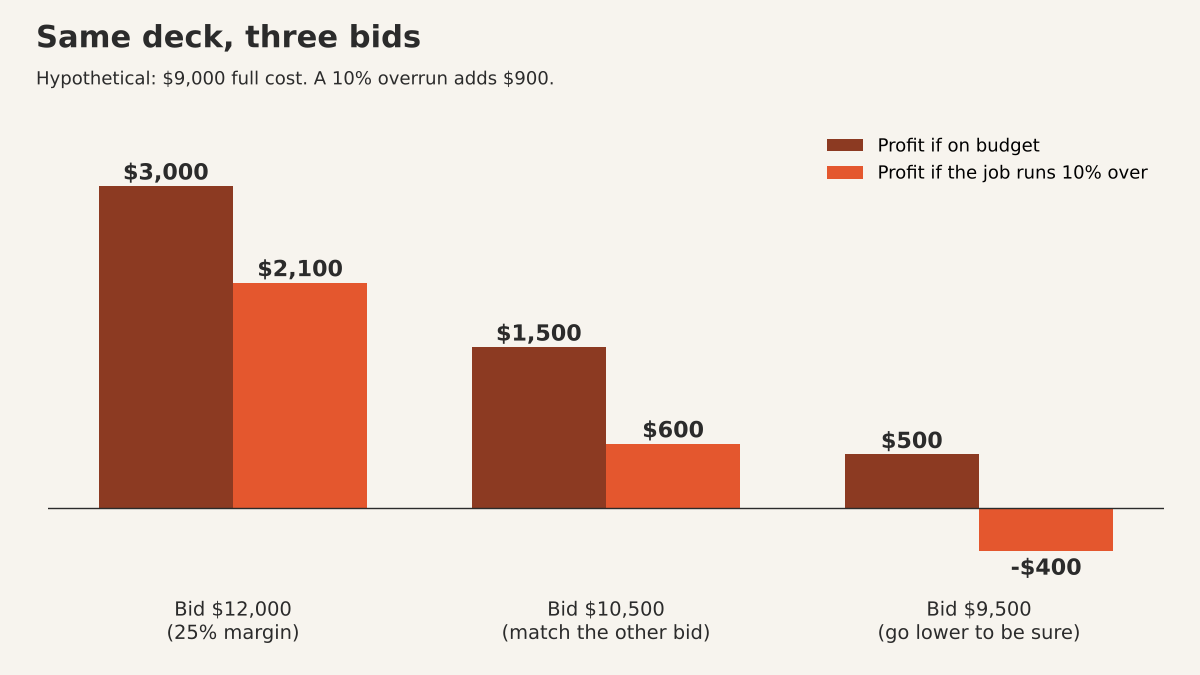
Now the make-up math. Going from $12,000 to $9,500 gives up $2,500 of profit. To earn $2,500 back at a 25% margin, you need $2,500 ÷ 0.25 = $10,000 of extra work. That's most of another deck, just to get back to where the first one should have left you.
And the $400 loss in the overrun case? $400 ÷ 0.25 = $1,600 of extra work to cover it.
4. "Win it now, make it up later" rarely works
The usual plan behind a deliberate low bid is the one FAR describes: make it up on change orders, or on the next job. Here's why that's harder than it sounds:
- The customer anchors on your number. Every change order after a low bid looks like a markup on a favor. Price them right anyway; see construction change orders.
- The next job starts from the last price. If the deck was $9,500, the railing next spring is expected to be cheap too.
- Bigger customers watch for it. FAR 3.501-2 says "Buying-in may decrease competition or result in poor contract performance." It also tells federal contracting officers to keep buy-in losses from being recovered through change orders or follow-on contracts (FAR 3.501-2).
- The profit you gave up is gone for sure. The make-up work is a maybe.
5. Signs your bids are too low
You don't need a report to spot it. Look for these:
- Customers say yes on the spot, with no questions about price.
- You're busy every week and the bank account doesn't show it.
- Jobs almost never finish under the estimate.
- You can't pay yourself a steady wage on top of the crew.
- You keep "throwing in" small items to close the deal.
One of these can be a fluke. Three of them is a pricing problem.
6. How to stop underbidding
Price from your full cost, not from what you think the customer will pay. Then decide on purpose if you want to go lower.
- Build the full cost: loaded labor including your own hours, materials with waste, site costs, setup and cleanup. The process is in how to estimate construction costs.
- Divide by (1 − margin). Check it in the profit margin calculator.
- Carry a contingency on jobs with unknowns. See construction contingency.
- Set a walk-away price before you talk to the customer: the lowest number where the job still covers cost and overhead. Below it, you say no.
- If the price feels high, cut scope, not margin. Offer a smaller deck, a simpler railing, or the customer buys the fixtures.
- Check the estimate before you send it. A second look catches the missing dumpster before the customer signs.
7. What to do when a competitor underbids you
You won't win every low-price fight, and you don't need to. A few moves that hold up:
- Ask what the other bid includes. Permit? Haul-off? Footings to code? The cheap bid often leaves out what yours includes.
- Show your scope line by line, with exclusions written down, so the customer can compare. See construction scope of work.
- Offer a reduced-scope option at a lower price, instead of the same job for less.
- Let it go. If the other contractor really can build it for $9,500 and you can't, they can have it.
Bidding commercial work against a list of competitors? The process side is in how to bid construction jobs.
Common underbidding questions
What is underbidding in construction?
Underbidding is submitting a price that's too low to cover the job's full cost plus a fair profit. It can be deliberate, to win the work, or accidental, from costs left off the estimate. Either way, once the customer signs, the gap between your price and the real cost comes out of your profit.
Is underbidding illegal?
Pricing your own residential work low isn't generally illegal. On federal contracts, FAR calls it buying-in and tells contracting officers to keep buy-in losses from being recovered through change orders or follow-on work. Public bids can have their own rules about prices that look too low. If you bid public work, read the solicitation.
How do I know if my bid is too low?
Compare it to your full cost: loaded labor, materials with waste, site costs, setup and cleanup, then divide by one minus your target margin. If your price is below that number, it's low. Other signs: customers say yes instantly, you're busy but short on cash, and jobs rarely finish under the estimate.
Should I ever bid a job at cost?
Rarely, and only on purpose. A job at cost still has to cover overhead you pay anyway, and any overrun becomes a loss. If you need to fill a gap in the schedule, offer a smaller scope or a later start date at your normal price before you cut margin.
How much lower than a competitor should I bid?
You shouldn't set your price from theirs. You don't know what their bid includes or what it costs them to build. Price from your own full cost and margin. If you lose on price, ask the customer what the other bid included, and offer a reduced-scope option instead of a discount.
What to do on your next bid
Before you send it, write down your full cost and your walk-away price. If the number you're about to send is below the walk-away price, you're underbidding. Change the scope or let the job go.
Working on directed changes after the bid? Construction change directives covers how to price and bill them.
Already sent one? Upload it to the estimate checker and see if it's priced too low.