Construction Estimating Mistakes That Cost You Margin
Eight estimating mistakes that turn a 25% job into a 4% job, with a worked bathroom example and a five-minute check before you send.

The construction estimating mistakes that hurt most aren't math errors. They're costs that never made it onto the estimate: unloaded labor, no waste on materials, a forgotten dumpster, the setup day, and markup used where you meant margin. Each one is small. Together they can turn a 25% job into a 4% job.
Price = full cost ÷ (1 − margin). Every mistake below either shrinks "full cost" or breaks the formula.
Hypothetical bathroom remodel: sent at $11,500 thinking it was a 25% job, it actually cost $11,038 to build. Profit: $462. Worked below.
Why it matters: you can't fix a bad estimate after it's signed. The customer agreed to the number. Whatever you left out comes out of your pocket.
Scope: US contractors and remodelers on small residential jobs. All dollar figures are hypothetical. For the full process from scratch, read how to estimate construction costs.
1. Using markup when you meant margin
This is the most expensive mistake on the list because it hits every job. A 25% markup on cost is not a 25% margin. Add 25% to $9,200 of cost and you get $11,500. Your margin on that is $2,300 ÷ $11,500 = 20%.
If you want a 25% margin, divide: $9,200 ÷ 0.75 = $12,266.67. The full explanation, with a conversion table, is in contractor markup. Or check a number in the profit margin calculator.
2. Pricing labor at the wage, not the loaded cost
An employee who makes $30 an hour costs you more than $30 an hour. You pay your share of payroll taxes on top. Per the IRS: "The current tax rate for Social Security is 6.2% for the employer and 6.2% for the employee, or 12.4% total. The current rate for Medicare is 1.45% for the employer and 1.45% for the employee, or 2.9% total." (IRS Topic 751.)
That's 7.65% before workers' comp, unemployment insurance and paid time off. The example below uses a 20% total load as an assumption. Figure your own with labor burden.
3. No waste factor on materials
You measure 96 square feet of tile and buy 96 square feet of tile. Then you cut around the toilet flange. Every material that gets cut, broken or returned short needs a waste factor on top of the measured quantity.
The example uses 10%, an assumption. Your number depends on the material and the layout. How to measure first and add waste after is in construction takeoff.
4. Forgetting site costs, setup and cleanup
The customer didn't ask for a dumpster, but the job needs one. Same for the permit, floor protection, the setup day and the final haul. These don't show up when you price the work item by item, so they don't show up at all.
- Site costs that run during the job: dumpster, toilet, protection, permit. See general conditions.
- Start and finish costs: equipment trips, setup, demobilization. See mobilization in construction.
- Cleanup. Forgot to include cleanup? Your margin noticed. Add it before you send the estimate.
5. No overhead in the price
Your truck, insurance, phone and software get paid by somebody. If they aren't in your price, that somebody is you. Overhead isn't a job cost line, but your margin has to be big enough to cover it and still leave profit.
If you've never worked out what your overhead runs per year, start with construction overhead. A margin that looks healthy on paper can be all overhead and no profit.
6. Scope gaps: what you didn't say you'd exclude
If the estimate says "remodel bathroom" and nothing else, the customer will assume the new exhaust fan, the paint in the hallway and moving the light switch are included. Anything not excluded in writing becomes an argument at the final invoice.
List what's in, and list what's out: "Excludes: hallway paint, electrical beyond fixture swap, anything behind the wall not visible at walkthrough." The format is in construction scope of work.
7. No contingency for what you can't see
Old house, closed walls, a floor that's "probably fine". If the job has unknowns, the estimate needs a line for them, or a written plan for how they'll be priced when you find them. Jobs run long. Price like it.
How much to carry and how to word it to the customer is in construction contingency.
8. Stale prices and quotes you didn't read
Material prices from the last job, a sub quote from four months ago, or a sub quote that quietly excludes the part of the work you thought was in it. Get fresh numbers on anything big, and read every sub quote's exclusions against your scope before you add it.
Put an expiration date on your own estimate too, so a customer can't sign your spring price in the fall.
9. Worked example: the same bathroom, priced twice
Hypothetical bathroom remodel: 80 hours of crew labor at a $30 wage, $4,200 of measured materials and a $2,600 plumbing sub. The first estimate makes four of the mistakes above. The second fixes them.
| Line | Estimate as sent | Fixed estimate |
|---|---|---|
| Labor, 80 hrs | $2,400 (wage only) | $2,880 (wage × 1.20 load) |
| Materials | $4,200 (no waste) | $4,620 (+10% waste) |
| Plumbing sub | $2,600 | $2,600 |
| Dumpster and permit | $0 (forgot) | $650 |
| Cleanup and haul, 8 hrs | $0 (forgot) | $288 (8 × $36 loaded) |
| Cost | $9,200 | $11,038 |
| Pricing step | 25% markup: × 1.25 | 25% margin: ÷ 0.75 |
| Price | $11,500 | $14,717.33 |
Here's what really happens to the estimate as sent. The job still costs $11,038 to build, because the load, the waste, the dumpster and the cleanup happen whether you priced them or not. Profit is $11,500 − $11,038 = $462. That's a 4.0% margin on a job you thought was 25%.
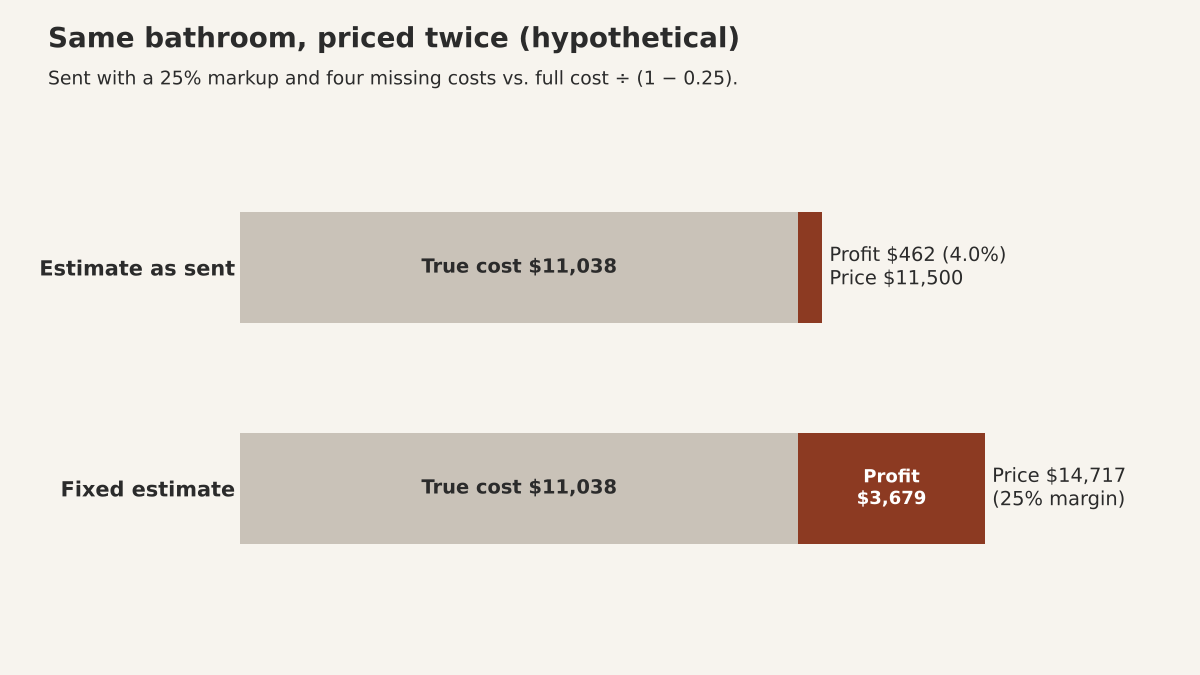
The fixed estimate is $3,217.33 higher. If that sounds like a lot to add to a bathroom, it's because it was always there. The first estimate just didn't say so.
10. A five-minute check before you hit send
- Did I divide by (1 − margin), or did I multiply by a markup?
- Is labor at loaded cost, including my own hours?
- Does every cut material have a waste factor?
- Dumpster, permit, protection, setup, cleanup, haul: are they on it?
- Are exclusions written down?
- Are big prices and sub quotes current, and did I read the sub's exclusions?
- Is there a contingency or a written plan for unknowns?
- Does the estimate have an expiration date?
Want a layout that has lines for all of it? Start from the construction estimate template.
Sending a low number on purpose to win the job? Run the make-up math first: underbidding shows what a low bid really costs.
Common construction estimating mistakes questions
What is the most common estimating mistake in construction?
Leaving costs off the estimate. Unloaded labor, no waste factor, and site costs like the dumpster, permit, setup and cleanup are the usual ones, because they don't show up when you price the work item by item. A close second is using a markup when you meant a margin, which quietly cuts profit on every job.
How do I avoid underbidding a job?
Price from full cost, not from what you think the customer will pay. Load your labor, add waste to materials, include every site cost, write down exclusions, and carry a contingency on unknowns. Then divide by one minus your margin. If the number feels high, cut scope, not margin.
What happens if I underestimate a job?
Once the customer signs, the price is the price. Anything you left out is paid by you. In the hypothetical example here, four small misses turned a 25% target into a 4.0% margin. Only scope changes the customer agrees to, by signed change order, let you add money later.
Is it a mistake to show my markup on the estimate?
Not a mistake, but it's usually unnecessary. Most residential customers see one price per line or one total. Showing the markup invites them to negotiate it. Keep the cost and margin math in your own numbers, and show the customer the scope, the price and what's excluded.
How can I check an estimate before sending it?
Run a short checklist: margin formula, loaded labor, waste, site costs, exclusions, current prices, contingency and an expiration date. Then have a second set of eyes look at it. That can be a partner, an estimator you trust, or the WinPal estimate checker, which reviews an uploaded estimate for underpricing.
What to do on your next estimate
Before you send it, run the eight-question check above. Fix the formula first, then the missing costs. If the price goes up, the job didn't get more expensive. Your estimate just caught up with it.
Already sent one? Upload it to the estimate checker and see if it's priced too low.