Mobilization in Construction: What It Covers and How to Price It
What mobilization covers, how to price it from real costs, and when to bill it, with a hypothetical $54,144 hardscape bid.
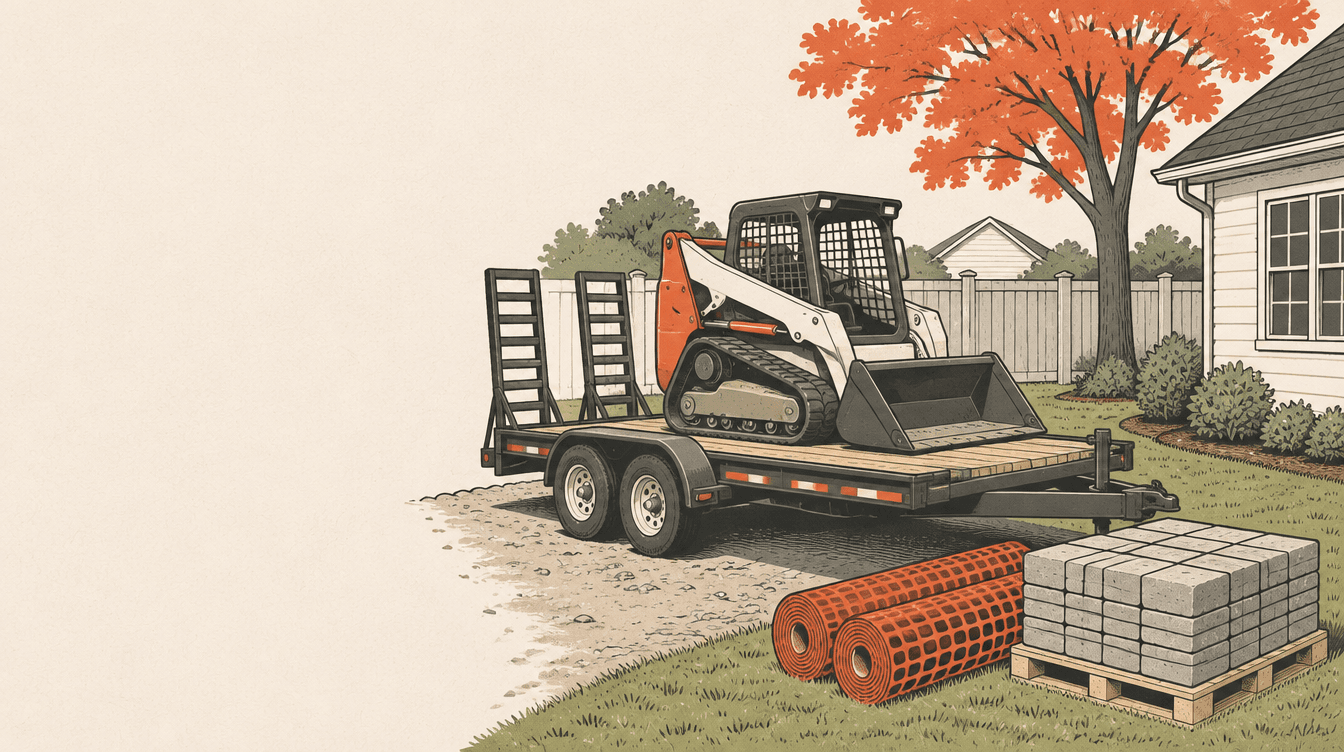
Mobilization in construction is the work and cost of getting your crew, equipment and site set up before the real work starts: hauling machines in, setting up fencing and temporary facilities, pulling the permit, laying out the job. Demobilization is the same thing in reverse at the end. On a bid, it's usually one lump-sum line called "Mobilization", billed early in the job.
Mobilization price = (move-in costs + setup costs + demobilization costs) ÷ (1 − margin).
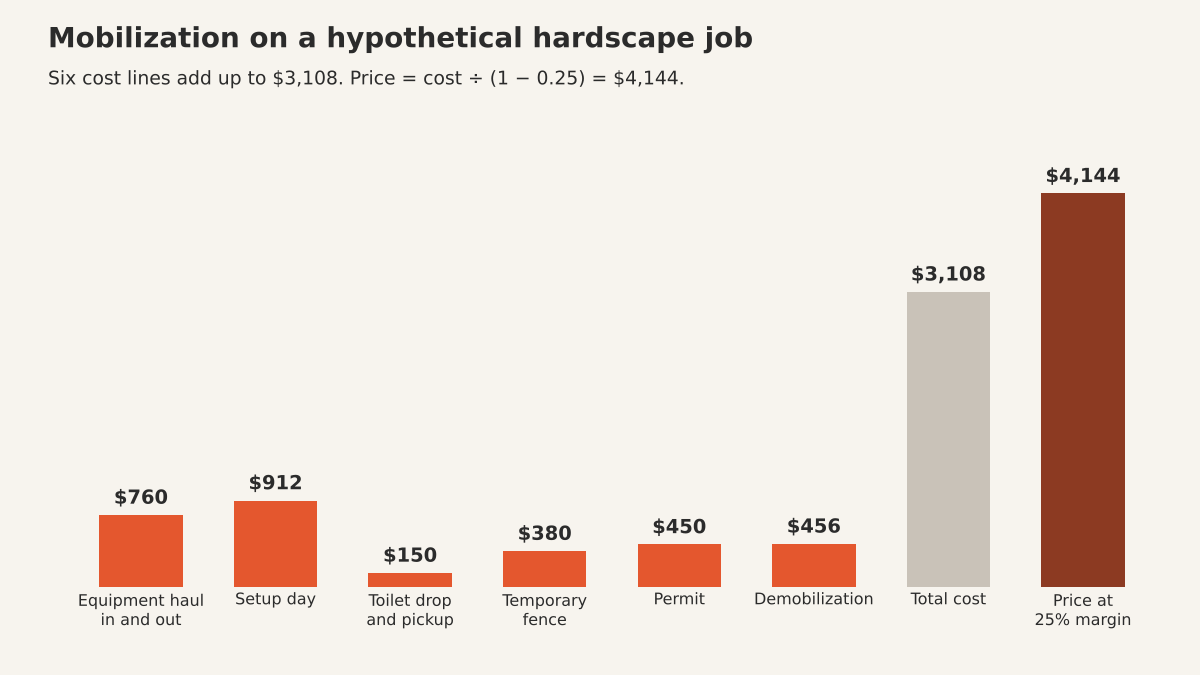
Hypothetical hardscape job: $3,108 of mobilization costs at a 25% margin is a $4,144 line on a $54,144 bid. Worked below.
Why it matters: the first week of a job is the most expensive week you don't see on the estimate. Trailer trips, a setup day with nothing built, a permit fee. If it isn't a line, it's coming out of your pocket.
Scope: US contractors running small crews, residential and light commercial. All dollar figures are hypothetical. If you're still building the rest of the estimate, start with how to estimate construction costs.
1. What is mobilization in construction?
Here's how one public owner writes it into its contracts. Iowa DOT's standard specification describes mobilization as "Preparatory work and operations for all items under the contract", including "The movement of personnel, equipment, supplies, and incidentals to the project site" and "The establishment of all offices, buildings, and other facilities necessary for work on the projects". It adds: "Mobilization may include bonding, permit, and demobilization costs." (Iowa DOT Section 2533, revised 10/20/2026.)
Your homeowner won't use that language. But the idea is the same on a patio job as on a highway: it's everything you spend before the first real unit of work goes in, plus getting back out.
2. What goes in mobilization, and what doesn't
Mobilization is one-time costs tied to starting and finishing. Costs that run for as long as the job runs belong somewhere else.
| Usually mobilization | Usually somewhere else |
|---|---|
| Hauling equipment and materials to the site, and back | Equipment rental by the day or week (job cost line) |
| Setup day: layout, silt fence, protection, staging area | Weekly site costs like a portable toilet rental (general conditions) |
| Delivery and pickup fees for a toilet, fence or dumpster | Dumpster swaps during the job (general conditions) |
| Permit and bond costs, if the contract puts them here | Your truck, insurance and office (overhead, in the price) |
| Demobilization: final haul out, removing temporary items | Punch list work and final cleaning (their own lines) |
Pick a rule and use it on every bid. It doesn't matter much where a cost lives. It matters a lot that it lives somewhere.
3. How to price mobilization
Price it from your real costs, not from a percentage you heard somewhere. Walk through the first and last days of the job and write down what you spend.
- Trips. Count every trailer trip, in and out. Two machines and one truck means four trips, not one.
- Setup labor. Hours for layout, fencing, protection and staging, at your loaded labor cost (see labor burden).
- Delivery fees. Toilet, temporary fence, dumpster, rentals. Most vendors charge to drop and to pick up.
- Permit and bond, if your contract doesn't list them on their own lines.
- Demobilization. The haul out and the cleanup of temporary items. This is the part people forget because it's months away when they bid.
Then put margin on it like any other cost line, using price = cost ÷ (1 − margin). Mobilization isn't a pass-through. Your crew is working, your truck is on the road, and that time needs profit too.
4. Worked example: a hardscape job
Hypothetical paver patio and retaining wall job for a landscaping crew. Loaded labor is $38 an hour and a truck with driver costs $95 an hour (both assumptions). Margin target is 25%.
| Mobilization cost line | Math | Cost |
|---|---|---|
| Equipment haul, in and out | 4 trips × 2 hrs × $95 | $760 |
| Setup day: layout, silt fence, protection | 3 people × 8 hrs × $38 | $912 |
| Portable toilet drop and pickup | Vendor fee | $150 |
| Temporary fence delivery and install | Vendor fee | $380 |
| Permit | City fee | $450 |
| Demobilization: haul out and cleanup | 2 people × 6 hrs × $38 | $456 |
| Mobilization cost | $3,108 | |
| Price at 25% margin | $3,108 ÷ 0.75 | $4,144 |
The rest of the job costs $37,500, priced the same way: $37,500 ÷ 0.75 = $50,000. The bid total is $50,000 + $4,144 = $54,144, and mobilization is about 7.7% of it.
Leave this off the bid and you're not just missing $3,108. At a 25% margin on the rest of the job, you've cut your planned profit from $13,536 to $9,392.
5. Show it as a line, or build it into the price?
Iowa DOT's spec covers both: when the proposal has a lump sum mobilization item, the bid price for it "is the contract price for this item", and when it doesn't, "all costs incurred by the Contractor for Mobilization are incidental to other work." Either way the cost is paid for. The question is only where the customer sees it.
- Show it on jobs with heavy equipment, a setup day, or a payment schedule. It explains why the first invoice comes early.
- Build it in on small service jobs. A homeowner with a leaky faucet doesn't need a mobilization line. That's what a trip charge or a minimum is for.
Either way, write down what it covers. "Mobilization: equipment delivery and removal, site setup, temporary fence, permit" answers the question before the customer asks it. Use the construction estimate template if you want a line-item layout to start from.
6. How to bill mobilization
Mobilization is front-end cost, so it's normal to bill it early: on the deposit invoice or the first progress invoice. That's fair as long as the number matches what you actually spend up front.
Public owners often stage it. Iowa DOT, for example, pays a first partial payment of "either 10% of the contract price for this item or 1% of the original project sum, whichever is less", and by the time 25% of the original project sum is earned, "either 100% of the contract price for this item or 10% of the original project sum, whichever is less". That's their rule for their own contracts, not a law for private jobs. Read the payment terms on any job you bid.
On the example job, the 10% rule gives a first payment of $414.40, since 1% of $54,144 is $541.44. Iowa holds partial payments under $1,000 until 5% of the job is earned, so that one would wait. By 25% earned, the full $4,144 would be paid, because 10% of the project is $5,414.40.
What not to do: load profit from later phases into the mobilization line to get cash early. Owners and lenders spot it, and it's the same problem as front-loading a schedule of values. If you need early cash, ask for a real deposit. Billing it in stages is covered in progress billing.
7. Charge for remobilization
The customer stops the job for three weeks to "think about the stone color". You pull the machines, come back, and set up again. That's a second mobilization, and it costs the same as the first.
Put a remobilization clause in your contract: if the owner stops or delays the job, coming back is billed at your mobilization cost plus margin, by change order. Price it from the same table. On the example job, a second haul in and out plus a half setup day is $760 + $456 = $1,216 of cost, or $1,621.33 at a 25% margin.
Check your mobilization line with the rest of the estimate. Most of the usual misses are in construction estimating mistakes.
Common mobilization questions
What does mobilization mean in construction?
It's the work and cost of starting a job: moving people, equipment and supplies to the site, setting up temporary facilities like fencing and toilets, and doing the prep that has to happen before the first real work item. It often includes permits and demobilization at the end. On a bid it's usually one lump-sum line.
What is included in mobilization costs?
Equipment and material hauling in and out, setup labor for layout, fencing and protection, delivery and pickup fees for rentals, and often the permit and bond. Demobilization, the haul out and cleanup of temporary items, belongs in it too. Weekly costs that run through the job, like toilet rental, usually sit in general conditions instead.
How much should I charge for mobilization?
Price it from your costs, not a rule of thumb. Count every trip, setup hours at loaded labor cost, vendor drop and pickup fees, the permit and the demobilization work, then divide by one minus your margin. In the hypothetical example here, $3,108 of cost became a $4,144 line, about 7.7% of the bid.
What is demobilization in construction?
Demobilization is mobilization in reverse: hauling your equipment and leftover materials off site, removing temporary fencing, toilets and protection, and leaving the site clean. Contracts often combine it with mobilization in one line. Price it when you bid, because it happens months later and is easy to forget.
Is mobilization the same as general conditions?
No, but they're neighbors. Mobilization is the one-time cost of starting and finishing the job. General conditions are the site costs that run for as long as the job runs, like toilet rental, dumpster swaps and supervision time. Some contractors fold mobilization into general conditions. Pick one rule and use it on every bid.
What to do on your next bid
Walk through the first and last days of the job. Count the trips, the setup hours, the vendor fees and the permit, add demobilization, and put margin on it. Show it as a line on equipment jobs, and add a remobilization clause to the contract.
Already sent the estimate? Upload it to the estimate checker and see if it's priced too low.