Construction Change Directive: How to Price It and Get Paid
A change directive means you do the work now and prove the price later. What to log every day, how the fee works, and how to bill it before it's settled.
A construction change directive (CCD) is a written order from the owner, prepared by the architect, that tells you to go ahead with changed work before anyone has agreed on the price or the schedule. You do the work now and settle the money later. So the price you end up with depends on one thing: how well you tracked every hour, receipt and delivery while you did it.
Directive price = documented cost + the fee your contract allows for changes.
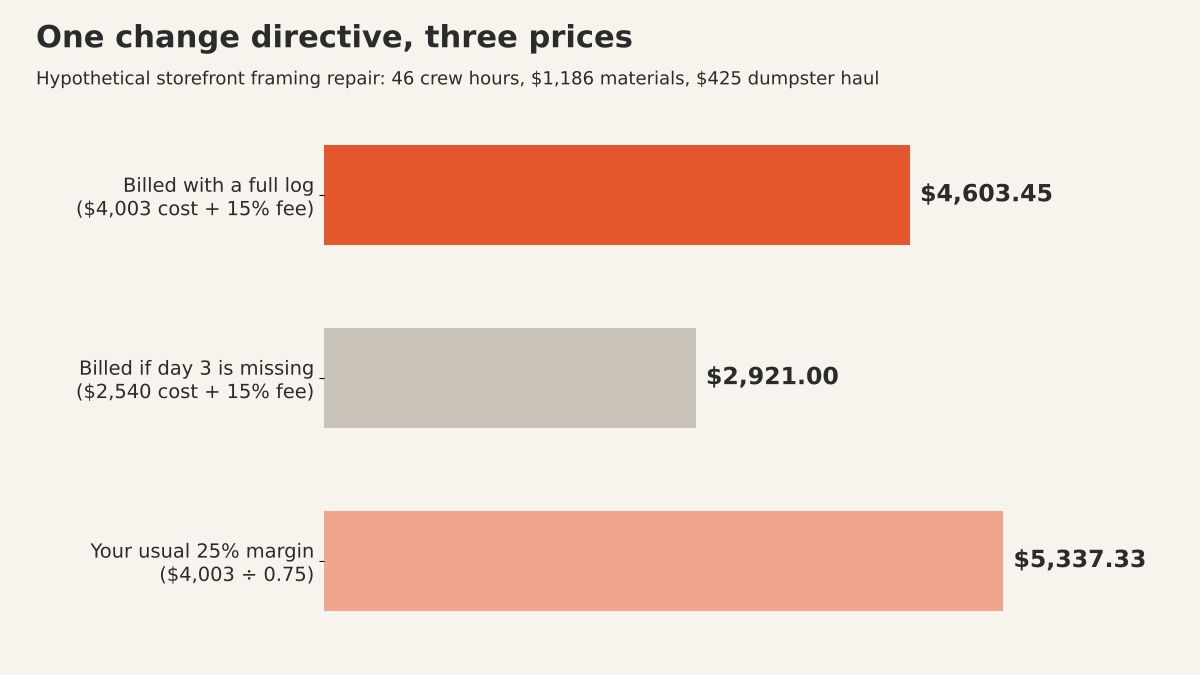
Hypothetical storefront repair: $4,003 of logged cost plus a 15% contract fee = $4,603.45. Lose one day of records and it drops to $2,921. Worked below.
Why it matters: a change order is a price you agreed to. A directive is a price you have to prove. If it isn't written down, it didn't happen, at least not on the invoice.
Scope: US contractors and subs on jobs that use AIA-style contracts or public owner contracts. All dollar figures are hypothetical. This isn't legal advice; your contract's changes clause decides the details. For everyday changes the customer signs first, read construction change orders.
1. What is a construction change directive?
It's the owner's way of saying "do it now, we'll agree on the number later." AIA defines it this way: "A construction change directive (CCD) is a written order from the owner that is prepared by the architect directing the contractor to proceed with changed work before the parties have agreed on the cost or schedule impact." (AIA Contract Documents.)
On AIA projects the form is G714. Other contract forms and public owners use their own names for the same idea, such as a work change directive or a written order under a changes clause.
The part that surprises people: you don't have to sign it for it to count. Per AIA, "the owner can issue a construction change directive without the contractor’s signature". The contractor is "generally required to proceed with the directed work under the terms of the contract."
2. Change directive vs change order
The difference is agreement. A change order is signed by everyone with the price and time settled. A directive starts the work first and settles the price after.
| Change order | Change directive | |
|---|---|---|
| Price and time | Agreed before work starts | Settled after, from your records |
| Who signs | Owner, contractor (and architect on AIA jobs) | Owner and architect; you sign only if you agree |
| Your risk | Low: the number is fixed | Higher: the number is whatever you can document |
| AIA form | G701 | G714 |
Once the price is agreed, the directive usually gets turned into a regular change order. Until then, it's an open item on your books.
3. When you'll get one
Directives show up when the work can't wait for a negotiation. AIA's own example is an unforeseen site condition found during excavation. Other common ones:
- Something nobody could see: rotted framing behind a storefront, a drain line where the plans show slab.
- Safety or code: the inspector wants a change and the schedule can't stop.
- Owner urgency: they need it done before the opening date.
- A price you couldn't agree on: you quoted the change, they said no, and they still want it built.
That last one is the uncomfortable kind. It's the owner telling you to proceed while you still disagree on the number.
4. What to do the day it arrives
Read it before anyone picks up a tool. Then do four things, in writing.
- Confirm the scope. Write back what you understand the change to be. Vague directive, vague invoice.
- Find your changes clause. It says how the price will be set: agreed lump sum, unit prices, or cost plus a fee. More on that in section 7.
- Put any disagreement on record. Procore's counsel puts it plainly: "When a contractor disputes the adjustment, they should submit a written statement." That's your notice that you're proceeding under protest.
- Start a separate log for the directed work, with its own job code, from the first hour.
5. What to track every day
Everything that went into the changed work, kept apart from the base contract. If the base work and the change share a crew, split the hours each day, not at the end of the month.
- Labor: who, how many hours, on what. Price it at your loaded cost, not the wage. See labor burden for what belongs in that rate.
- Materials: every receipt, tagged to the directive.
- Equipment and trucking: rentals, extra dumpster hauls, deliveries.
- Subs: their invoices for the directed work only.
- Photos and notes: what you found, what you did, dated.
- Time: days the change added, and what it pushed.
A good daily sheet takes ten minutes at the end of the shift. Rebuilding three weeks from memory takes a weekend and still comes up short. If you already track estimate vs actual on jobs, it's the same habit; see construction job costing.
6. Worked example: rotted framing on a storefront job
Hypothetical: you're the contractor on a small retail build-out. During demo you find rotted framing and sheathing under the storefront window. The owner issues a directive to replace it now. Your contract says changes are priced at documented cost plus a 15% fee for overhead and profit.
Two carpenters work three days on it at a loaded cost of $52 an hour (an assumption for this example). Here's the log:
| Day | Labor | Materials | Other | Day total |
|---|---|---|---|---|
| Day 1 | 16 hrs × $52 = $832 | $642 | $0 | $1,474 |
| Day 2 | 16 hrs × $52 = $832 | $234 | $0 | $1,066 |
| Day 3 | 14 hrs × $52 = $728 | $310 | $425 extra dumpster haul | $1,463 |
| Total | 46 hrs = $2,392 | $1,186 | $425 | $4,003 |
The adjustment: $4,003 × 1.15 = $4,603.45.
Now say nobody filled in day 3. The foreman meant to, then the week got away from him. Documented cost drops to $2,540, and the adjustment drops to $2,540 × 1.15 = $2,921.00. That's $1,682.45 you spent and can't prove.
7. How the price gets set
Your changes clause decides. AIA says that if the parties can't agree in advance, A201 sets the amount "through the pricing methods in the owner-contractor contract, or, if needed, by the architect based on the contractor’s documented costs." The usual methods:
- Agreed lump sum: you and the owner settle on one number after the fact.
- Unit prices: if the contract lists a price per foot or per item, the quantities do the math.
- Cost plus a fee: your documented cost plus the overhead and profit percentage in the contract. This is the one that depends entirely on your log.
Watch the fee. A 15% fee on cost is a markup, not a margin. In the example, $600.45 of fee on a $4,603.45 price is a 13.0% margin. If you normally price work at a 25% margin, the same change would be $4,003 ÷ (1 − 0.25) = $5,337.33. That gap is set when you sign the contract, not when the directive arrives. Check the math in the profit margin calculator and read contractor markup for the difference.
How the contract type changes this is covered in types of construction contracts.
8. How to bill it while the price is still open
Don't wait for the final agreement to ask for money. AIA notes that until the change order is signed, "the contractor may continue documenting the directed work and include eligible costs in applications for payment while the final cost gets worked out."
- Give it its own line on the pay application, labeled with the directive number, so it doesn't get lost inside the base contract. See schedule of values.
- Attach the backup: the daily logs, receipts and photos for the period you're billing.
- Bill the part nobody disputes now, and keep the disputed part on the list.
- Expect retainage on it if your contract holds retainage on change work. See retainage.
Procore's counsel says the same thing from the other side: "Billing a change directive as one would bill a change order makes sense." The mechanics of billing in stages are in progress billing.
9. Federal jobs: watch the notice clock
On federal construction, the Changes clause at FAR 52.243-4 sets deadlines. If you're treating a written or oral order as a change, you give written notice, and "no adjustment for any change under paragraph (b) of this clause shall be made for any costs incurred more than 20 days before the Contractor gives written notice as required." You also "must assert its right to an adjustment under this clause within 30 days" after the written change order or your notice (FAR 52.243-4).
State and local owners have their own clocks. Find the number of days in your contract before you need it.
Common construction change directive questions
Do I have to do the work if I didn't sign the directive?
Usually yes, if your contract has a changes clause like AIA A201. AIA says the contractor is generally required to proceed, and refusing can be treated as a breach. Proceed, put your disagreement in writing, and track every cost. If you're unsure what your contract requires, ask a construction lawyer before you stop work.
Who signs a construction change directive?
On AIA projects, the owner and the architect. Your signature isn't required for the directive to take effect. You sign if you agree with the proposed cost and time. Once everyone agrees, the directive is normally turned into a signed change order that becomes part of the contract.
What's the difference between a CCD and a change order?
A change order is agreed and signed with the price and time settled before the work. A change directive tells you to proceed first and settles the price and time later, from the contract's pricing method and your records. The full change order process is in our guide to construction change orders.
How long do I have to price a change directive?
Whatever your contract says, and some deadlines are short. On federal jobs, FAR 52.243-4 gives 30 days to assert your right to an adjustment and limits recovery of costs from more than 20 days before your written notice. Send your pricing as soon as the work is done, with the logs attached.
Can I add overhead and profit to a change directive?
Yes, if your contract allows it, and most changes clauses do, often as a set percentage. Read the number before you sign the contract. A 15% fee on cost is a 13.0% margin, which is lower than many contractors price their regular work.
What to do before the next directive shows up
Find the changes clause in your current contract and write down two things: the pricing method and the fee. Then set up a one-page daily log your foreman will actually fill in: hours by person, receipts, equipment, photos.
When the price is settled, bill it as its own line and get paid for the whole job. Want the estimate, the change and the invoice in one place on your phone, with online payment for your customer? Get started with WinPal. Pricing a job you bid too low the first time? Read underbidding before the next one.