How to Sell Plumbing Services Without Cutting Your Price
Win the call, show the customer what you found, give priced options and follow up. A hypothetical water heater job shows what a 10% discount really costs.
To sell plumbing services, win the call before you roll, diagnose and show the customer what you found, give a written price with two or three options, price every option from your cost, and send it before you leave. Most plumbing sales are lost on the phone, in the driveway or in the week after, not in the pitch.
Price every option from cost: price = cost ÷ (1 − margin).
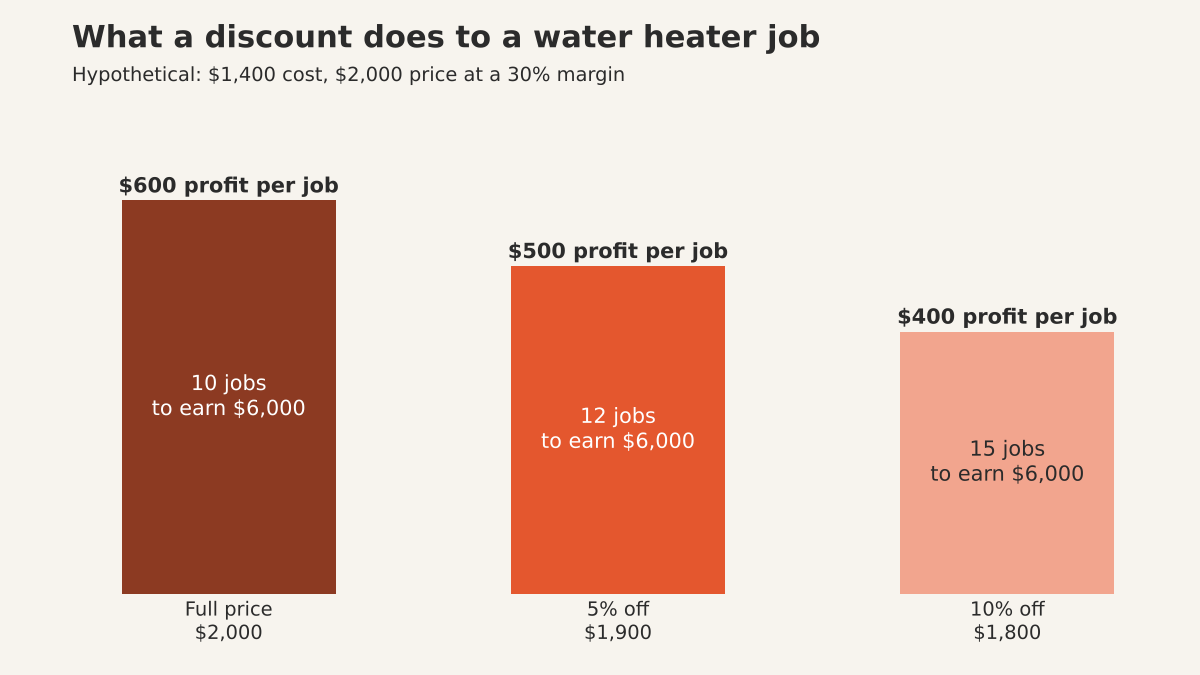
Hypothetical water heater replacement: $1,400 cost at a 30% margin = $2,000, so $600 of profit. Knock 10% off and profit drops to $400; you now need 15 jobs to earn what 10 used to. Worked below.
Why it matters: a plumber who sells well isn't the pushiest one. It's the one whose customer understands the problem, sees a clear price and has an easy way to say yes.
Scope: US residential plumbing service and replacement work, owner or tech doing the selling. All dollar figures are hypothetical. For the pricing side, see the plumbing flat rate pricing guide and how to estimate a plumbing job. This isn't legal advice.
1. Sell the call before you roll the truck
The first sale is the booking. A customer with water on the floor calls three plumbers and books the one who sounds like they know what they're doing.
- Answer or call back fast. A missed call at 7 a.m. is a job for the next shop.
- Ask three questions: what's happening, how old is the fixture or heater, and is the water shut off.
- Say your service call fee on the phone. No surprise at the door, no argument at the end. How to set it is in the plumbing flat rate pricing guide.
- Give a window and keep it. Text when you're on the way.
2. Diagnose, then show the customer
Find the problem before you talk price. Then show it. A photo of the corroded anode, the camera shot of roots in the line, the drip pan with rust in it: the customer believes what they can see.
Explain it in plain words. "Your heater is 13 years old and the tank is leaking at the bottom, so it can't be repaired" beats "you need a new unit." Then stop talking and let them ask.
Take the photos for your estimate too. They back up your price when the customer reads it again tonight next to another plumber's.
3. Give options, not one number
One price gets a yes or a no. Two or three get the customer choosing which yes. On plumbing calls the options are often already there:
- Repair or replace: fix the valve today, or replace the 15-year-old heater before it floods the basement.
- Like for like or upgrade: same 50-gallon tank, a longer-warranty tank, or tankless.
- Clear the drain or fix the cause: snake it today, or camera it and price the line repair.
Build the option you'd recommend first, then a basic and a premium version. The full method is in good better best pricing, which uses a water heater example too.
4. Price every option from your cost
Size the price to the job, not to the house. Here's a hypothetical 50-gallon gas water heater swap:
| Line | Cost |
|---|---|
| Water heater | $750 |
| Materials (venting connector, gas flex, expansion tank, fittings) | $180 |
| Permit | $75 |
| Labor: 4 h at $40/h | $160 |
| Haul-away of the old tank | $40 |
| Overhead share for the job | $195 |
| Total cost | $1,400 |
| Price at 30% margin: $1,400 ÷ 0.70 | $2,000 |
| Profit | $600 |
The $40 labor rate starts from the national median wage for plumbers, pipefitters and steamfitters, $30.67 an hour in 2025 (O*NET 47-2152), plus about 30% for payroll taxes, workers' comp and insurance. That load is an assumption, rounded. Use your own numbers.
Do the same for the other options. Say the longer-warranty tank costs you $1,750 all in: $1,750 ÷ 0.70 = $2,500. A tankless install at $3,500 of cost: $3,500 ÷ 0.70 = $5,000. Same margin on every option, so you don't care which one they pick. Check any of them in the profit margin calculator.
5. Don't sell with a discount
A discount feels like a small favor. On a 30% margin job it's a big one.
| Price | Profit per job | Jobs to earn $6,000 profit |
|---|---|---|
| $2,000 (full price) | $600 | 10 |
| $1,900 (5% off) | $500 | 12 |
| $1,800 (10% off) | $400 | 15 |
10% off the price takes a third of the profit. To earn the same $6,000, you have to sell, install and haul away five more water heaters.
When the customer says it's more than they wanted to spend, offer the cheaper option, not a cheaper version of your margin. Fixing the valve today is a real answer. Discounting the tank isn't.
6. When a repair call turns into a replacement
A lot of plumbing sales happen on a call the customer booked for something else. That's fine, and it changes the paperwork.
The FTC's Cooling-Off Rule covers sales of $25 or more at the buyer's home. It excludes a visit where the buyer "specifically requested the seller to visit the buyer's home for the purpose of repairing or performing maintenance upon the buyer's personal property," but adds that sales of "additional services or goods other than replacement parts necessarily used in performing the maintenance or in making the repairs" on that visit don't fall within the exclusion (16 CFR 429.0).
So the repair you were called for is one thing; the new heater you sell on that visit may need the 3-day cancellation notice. There's a narrow emergency exception too, and it needs the buyer's own handwritten, signed statement. The full rundown is in HVAC sales tips, section 6. Put the notice in your replacement paperwork, and have a lawyer check your contract once.
7. Send the estimate before you leave the driveway
A written price in their inbox while they're still talking about it beats "we'll email it tonight." Make it easy to read:
- What you found, with one or two photos.
- Each option, with the exact equipment, scope, warranty and price, your recommendation marked.
- Exclusions: drywall patching, code upgrades you can't see yet, anything that would be extra.
- Deposit, payment terms and an expiry date. See contractor payment terms.
In WinPal you can build a detailed estimate from a photo and a voice note, and the app suggests upgrades you can offer the client. When they say yes, you can invoice from your phone and let clients pay online.
8. Follow up, then count
"Let me think about it" isn't a no. Follow up like it's part of the job:
- Same day: a text that the estimate is in their inbox.
- Day 2 or 3: a call asking what questions came up.
- Before it expires: one last note.
Then track your close rate: jobs sold ÷ estimates given, by job type. Service repairs, water heaters and repipes each have their own number. "We sold 6 of 20 water heater estimates" is something you can improve. "Sales were slow" isn't.
Common plumbing sales questions
How do plumbers sell more jobs?
Raise the close rate on the calls you already get. Answer fast, say your service fee up front, diagnose and show the customer what you found, give two or three options priced from cost, send a written estimate before you leave, and follow up within a few days. Track close rate by job type.
How do you upsell plumbing services without being pushy?
Don't upsell; recommend. Show the customer what you found, explain the risk in plain words, and put the repair and the replacement side by side with honest prices. Let them choose. A tech who recommends what they'd put in their own house sells more than one reading a script.
Should you lower your price to beat another plumber's quote?
Usually not. Ask what's in their quote first: brand, warranty, permit, haul-away. If the scope really matches, offer a cheaper option instead of cutting yours. In the hypothetical example, 10% off a $2,000 job takes a third of the profit.
Should plumbers give prices over the phone?
Give your service call fee and a range for common jobs if you have a flat-rate book, but save the firm price for after you've seen it. A water heater swap and a water heater swap with a rotted floor and no expansion tank aren't the same job.
What is a good close rate for plumbing estimates?
There's no reliable public benchmark that fits every market, so don't chase someone else's number. Track your own by job type every month, with the denominator, and improve against your baseline. Watch that discounts aren't what's moving it.
What to do on your next plumbing call
Book it with the fee stated, diagnose and photograph, build the option you'd recommend plus a basic and a premium one, price each from cost with cost ÷ (1 − margin), and send all of them before you pull out. Then put the follow-up in your calendar.
Finishing a bigger remodel or repipe? The construction project closeout checklist covers getting the last payment in.
Already sent one? Upload it to the estimate checker and see if it's priced too low.