HVAC Sales Tips: How to Close More Estimates Without Discounting
Close more HVAC replacement estimates: diagnose and show, give options, price from cost, write an estimate that sells, follow up, and why a 10% discount needs a 42% close rate.

The best HVAC sales tips aren't scripts. They're about the estimate: get there fast, show the customer what you found, give them options, price every option from your cost, and send a clean written estimate before you leave the driveway. Then follow up, because a lot of yeses come after you leave.
Price from cost, not from the customer's face: price = cost ÷ (1 − margin).
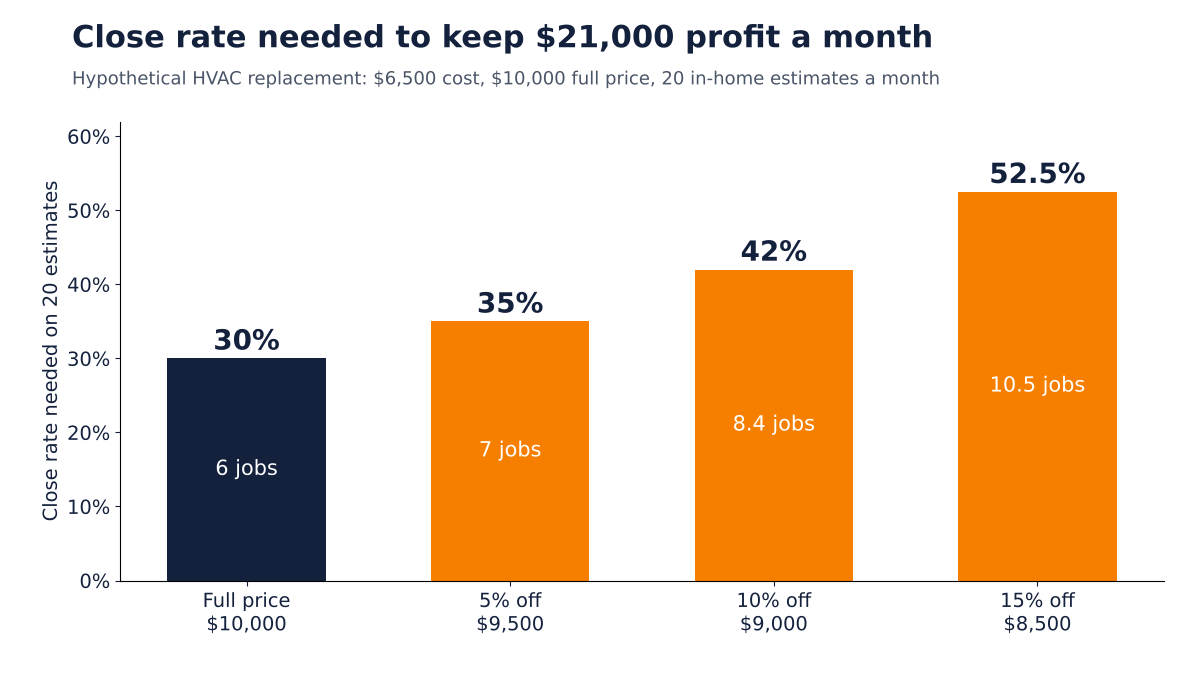
Hypothetical replacement: $6,500 cost at a 35% margin = $10,000. A 10% discount drops profit from $3,500 to $2,500, so your close rate has to go from 30% to 42% just to stand still. Worked below.
Why it matters: on replacement work, a few points of close rate are worth more than almost anything else you can change. And the fastest way to wreck a good close rate is to buy it with discounts.
Scope: US residential HVAC service and replacement shops, owner or tech doing the selling. All dollar figures are hypothetical. For the pricing side, see how to price HVAC jobs and the HVAC price book guide. This isn't legal advice.
1. Show up fast and diagnose before you sell
A no-cool call in July is a race. The shop that shows up first, finds the problem and explains it clearly usually gets the job, even if it isn't the cheapest.
Diagnose like a doctor, not a salesman. Test, measure, then tell the customer what you found in plain words. "Your compressor is pulling high amps and the unit is 17 years old" beats "you need a new system."
Take photos and readings. A picture of a rusted coil or a burnt contactor does more selling than anything you say. It also protects you later if the customer asks why the price changed.
2. Give options instead of one take-it-or-leave-it number
One price gets a yes or a no. Three prices get the customer picking which yes. On a replacement, that might be a basic single-stage system, a two-stage system with a longer warranty, and a variable-speed system with better filtration.
Build the middle option first, the one you'd put in your own house. Then take things out for the basic option and add real value for the top one. The full method is in good better best pricing.
Repair or replace is an option too. Put both on the estimate with honest numbers and let the customer decide. You'll lose fewer jobs to "let me think about it."
3. Price every option from your cost
If you size the price to how nice the house looks, you'll overprice some jobs and underprice the rest. Price every option from what it costs you, with the same formula.
Hypothetical 3-ton AC and furnace replacement for a residential shop:
| Line | Cost |
|---|---|
| Equipment | $4,200 |
| Materials (line set, pad, refrigerant, electrical) | $650 |
| Permit | $150 |
| Labor: 2 techs × 10 h = 20 h at $38/h | $760 |
| Overhead share for the job | $740 |
| Total cost | $6,500 |
| Price at 35% margin: $6,500 ÷ 0.65 | $10,000 |
| Profit | $3,500 |
The $38 labor rate starts from the national median wage for HVAC mechanics and installers, $29.33 an hour in 2025 (O*NET 49-9021), plus about 30% for payroll taxes, workers' comp and insurance. That load is an assumption, rounded. Use your own numbers, and check the margin in the profit margin calculator.
4. Don't buy the job with a discount
Here's what a discount does to that $10,000 job. Say you run 20 in-home replacement estimates a month and close 30% of them. That's 6 jobs × $3,500 = $21,000 of profit.
Now knock 10% off. The price drops to $9,000, the cost stays at $6,500, and profit falls to $2,500 a job. To make the same $21,000, you need $21,000 ÷ $2,500 = 8.4 jobs. That's a 42% close rate on the same 20 estimates.
| Discount | Price | Profit per job | Jobs to make $21,000 | Close rate needed on 20 estimates |
|---|---|---|---|---|
| None | $10,000 | $3,500 | 6 | 30% |
| 5% | $9,500 | $3,000 | 7 | 35% |
| 10% | $9,000 | $2,500 | 8.4 | 42% |
| 15% | $8,500 | $2,000 | 10.5 | 52.5% |
The customer who says "that's more than I wanted to spend" usually wants a cheaper option, not a cheaper version of your margin. Point them to the basic system instead.
5. Write an estimate that sells when you're gone
The customer will read your estimate again tonight, probably next to someone else's. Make yours the easy one to say yes to:
- Exact equipment: brand, model, size and efficiency rating, not "new AC system."
- Scope in plain words: what's removed, what's installed, what's hauled away, who pulls the permit.
- Warranty: parts and labor, separately, in years.
- Exclusions: duct changes, electrical panel work, anything you'd charge extra for.
- Options side by side, with your recommendation marked.
- Deposit and payment terms, and an expiry date. Equipment prices move; 30 days is plenty. See contractor payment terms.
Send it before you pull out. A written estimate in their inbox while they're still talking about it beats a "we'll email it tonight" every time. In WinPal you can build detailed estimates from a photo and a voice note, and the app suggests upgrades you can offer the client, so the options are on the estimate before you leave.
6. Get the in-home paperwork right
Selling a system at the customer's house has federal paperwork rules. The FTC's Cooling-Off Rule covers sales of $25 or more made at the buyer's home, including when the buyer invited you over (16 CFR 429.0).
For those sales, you must give the buyer a completed receipt or contract copy with a statement that they may cancel "at any time prior to midnight of the third business day after the date of this transaction," plus a notice of cancellation form (16 CFR 429.1).
The trap for HVAC: the rule excludes a visit the buyer asked for to repair or maintain their property, but not the extra goods or services you sell on that visit beyond the replacement parts the repair needs. So the replacement system you sell during a repair call can fall under the rule. There's also a narrow emergency exception that needs the buyer's own handwritten, signed statement waiving the right to cancel.
Practical move: put the cancellation statement and form in your replacement estimate paperwork, and schedule non-emergency installs after the cancellation window. State rules can add more, so have a lawyer check your contract once.
7. Follow up like it's part of the job
"We'll think about it" isn't a no. It's a customer comparing estimates, waiting on a spouse or checking their budget. Plenty of shops never call back, so the one that does has an edge.
- Same day: a short text that the estimate is in their inbox, with one line on your recommended option.
- Day 2 or 3: a call. Ask what questions came up, not "are you ready to buy?"
- Day 7: one last note before the price expires.
Three touches, then let it go. Write down why lost jobs were lost. Price, timing and trust are three different fixes.
8. Make yes easy and track your close rate
Take the deposit on the spot when they're ready. A customer who has to mail a check gets time to change their mind. With WinPal you can invoice from your phone and let clients pay online, so the deposit invoice goes out with the signed estimate.
Then count. Close rate is jobs sold ÷ estimates given, by job type: repairs, replacements and maintenance plans each have their own number. Track it monthly with the denominator. "We closed 7 of 22 replacement estimates" tells you something. "Sales were good" doesn't.
Want every replacement estimate to carry the same lines? Use the HVAC estimate checklist on site, before you price the options.
Common HVAC sales questions
How do you increase HVAC sales?
Raise your close rate before you chase more leads. Respond fast, diagnose and show the customer what you found, give two or three options priced from cost, send a clear written estimate before you leave, and follow up within a few days. Track close rate by job type so you know which fix worked.
What is a good close rate for HVAC replacement estimates?
There's no reliable public benchmark that fits every market, so don't chase someone else's number. Track yours: replacement jobs sold divided by replacement estimates given, every month. Then improve it against your own baseline, and watch that discounts aren't what's moving it.
Should HVAC techs sell?
Techs already sell every time they explain a repair. Teach them to diagnose, show the evidence and present options honestly, then hand replacements to whoever writes the estimate if they'd rather not. A tech who recommends what they'd put in their own house is your best salesperson.
Does the 3-day cancellation rule apply to HVAC sales?
Often, yes. The FTC Cooling-Off Rule covers sales of $25 or more at the buyer's home. A repair visit the customer requested is excluded, but extra goods or services sold on that visit, like a new system, are not. Give the cancellation notice and check your state's rules.
How fast should you follow up on an HVAC estimate?
Same day by text, then a call two or three days later, then one last note before the estimate expires. Ask what questions came up instead of pushing for a decision. Three touches is enough; after that, record why you lost it.
What to do on your next HVAC estimate
Diagnose and photograph, build the option you'd recommend plus a basic and a premium version, price each from cost with cost ÷ (1 − margin), and send all three before you leave. Then put the follow-up dates in your calendar.
Selling roofs too? See roofing sales tips for the roofing version.
Already sent one? Upload it to the estimate checker and see if it's priced too low.