HVAC Estimate Checklist: What Every Replacement Estimate Needs
The site checks and line items every HVAC replacement estimate needs, plus what four forgotten lines do to profit on a $10,000 job.
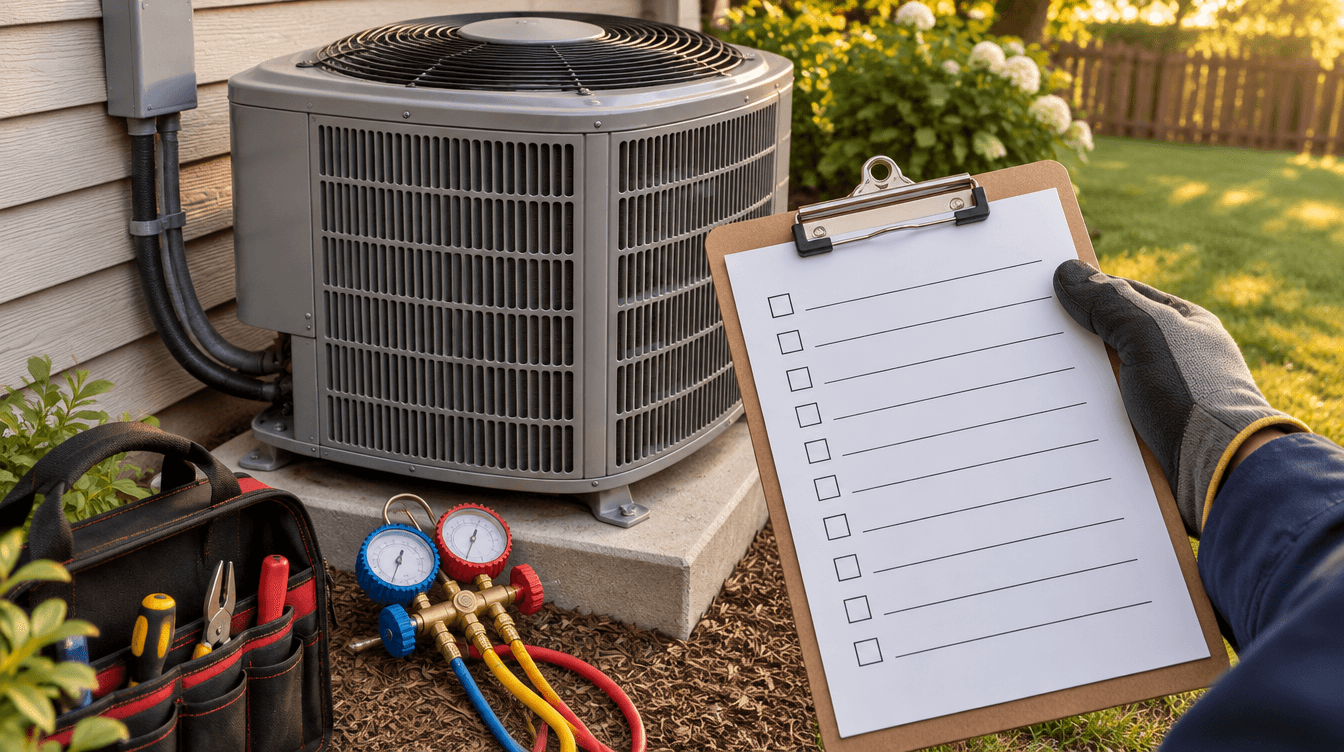
An HVAC estimate checklist makes sure every replacement estimate has the same parts before it goes out: a load calculation, exact equipment, the line set, electrical, condensate, venting, permit, removal and disposal, labor, warranty, exclusions, options, payment terms and an expiry date. The lines you forget come out of your profit, not the customer's price.
Price the full job from cost: price = cost ÷ (1 − margin).
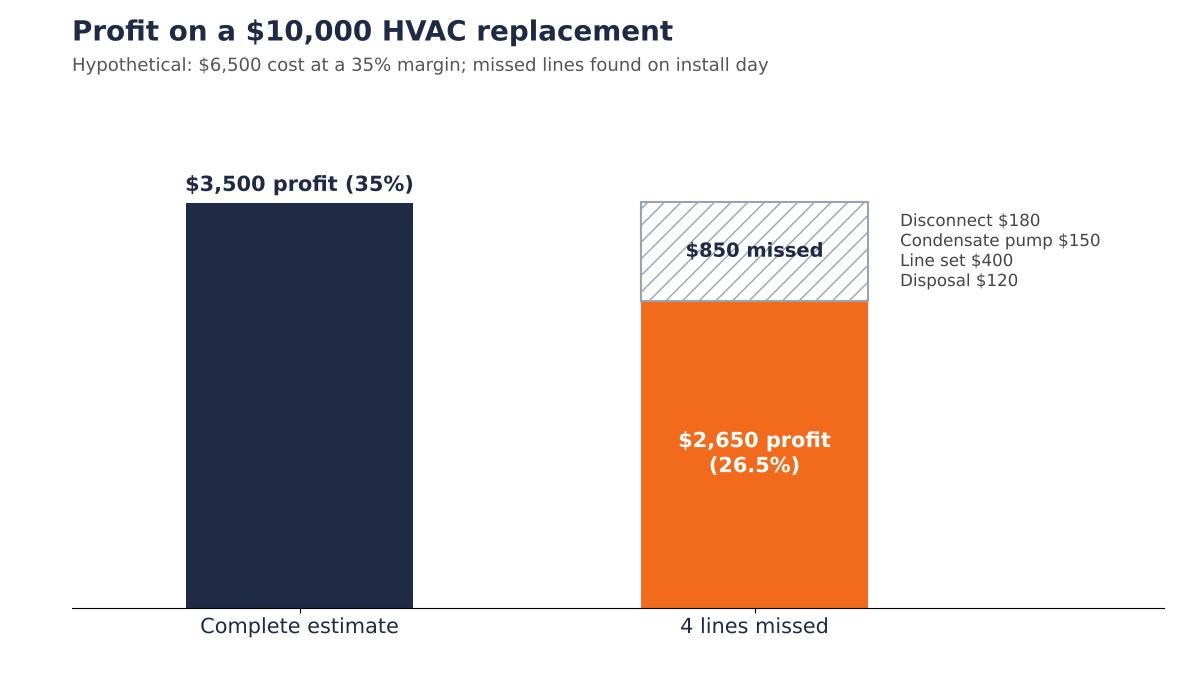
Hypothetical replacement: $6,500 cost at 35% = $10,000. Forget a $180 disconnect, a $150 condensate pump, $400 of line set work and $120 of disposal, and profit drops from $3,500 to $2,650. Worked below.
Why it matters: the customer only sees one number. If the disconnect is missing from your estimate, you still have to install it, so it comes out of your pocket.
Scope: US residential HVAC replacement and new-install estimates, written by the owner or the tech on site. Dollar figures are hypothetical. Pricing method: how to price HVAC jobs. Selling the estimate: HVAC sales tips.
1. Before you leave for the visit
Five minutes on the phone saves a second trip. Ask and note:
- What's wrong: no heat, no cool, noise, high bills, or a planned upgrade.
- Age of the system, and fuel: gas, electric, heat pump, oil.
- Where the equipment is: attic, crawlspace, basement, closet, roof.
- Who decides and who needs to be there for the estimate.
- Photos of the data plates, if they can send them.
2. What to check on site
Measure the house, not the old unit. Sizing a replacement to match the old nameplate repeats whatever mistake the last installer made.
- Load calculation: ACCA says a proper load calculation per Manual J 8th Edition "is required by national building codes and most state and local jurisdictions" (ACCA). Do it, and keep it with the estimate.
- Ductwork: size, condition, leaks, static pressure. Bad ducts can make a new system look broken.
- Line set: length, size, condition, and whether you'll reuse, flush or replace it.
- Electrical: breaker size, wire, disconnect, and whether the panel can take the new equipment.
- Condensate: drain route, pump needed, secondary pan or float switch in an attic.
- Venting: flue type and condition for a gas furnace; whether a high-efficiency furnace needs new PVC venting.
- Pad, stand and clearances: what the outdoor unit sits on, and whether it still fits the space.
- Thermostat and controls: compatibility with the new equipment.
- Access: attic stairs, tight closets, crane or extra hands for a rooftop unit.
Refrigerant work needs certified hands. EPA rules under Section 608 of the Clean Air Act "require that technicians who maintain, service, repair, or dispose of equipment that could release ozone depleting refrigerants into the atmosphere must be certified" (EPA). Make sure whoever does the recovery on this job is.
Take photos of everything. They back up your line items when the customer compares estimates tonight.
3. Line items every HVAC estimate should show
| Line | What to write | Often missed |
|---|---|---|
| Equipment | Brand, model numbers, size, efficiency rating, matched system | Coil or air handler model |
| Materials | Line set, pad or stand, refrigerant, fittings, filter base | Line set replacement or flush |
| Electrical | Disconnect, whip, breaker, wire | New disconnect |
| Condensate | Drain, pump, safety switch | Condensate pump |
| Venting and ducts | Flue or PVC venting, transitions, duct repairs | Transitions to the old plenum |
| Permit and inspection | Who pulls it, fee included | Re-inspection trip |
| Removal and disposal | Haul away old equipment, refrigerant recovery | Disposal fee |
| Labor | Crew size and hours, or by the job | Startup and commissioning time |
| Warranty | Parts and labor, separately, in years | Labor warranty terms |
| Exclusions | Panel upgrades, major duct work, drywall patching | Patching after a closet install |
For your standard line prices, build them once in a price book. See HVAC price book.
4. What forgotten lines cost you
Same hypothetical 3-ton AC and furnace replacement as in our sales guide: $6,500 of cost, priced at a 35% margin. $6,500 ÷ 0.65 = $10,000, so $3,500 of profit.
Now say the estimate missed four lines you found on install day:
| Missed line | Cost |
|---|---|
| New disconnect | $180 |
| Condensate pump | $150 |
| Line set replacement (part of it) | $400 |
| Disposal fee | $120 |
| Total | $850 |
The price is already signed at $10,000. Your cost is now $7,350, so profit falls to $2,650. That's a 26.5% margin instead of 35%, and $850 (about 24%) of your profit gone.
With those lines on the estimate, the right price was $7,350 ÷ 0.65 = about $11,310.
Forgot the condensate pump? Your margin noticed. Add it before you send the estimate.
5. Options and upgrades to put on the estimate
Give the customer two or three options instead of one number. Build the one you'd recommend first, then a basic and a premium version. The method is in good better best pricing.
Check the upgrades that fit this house:
- Higher efficiency or variable-speed equipment.
- Better filtration or a media filter cabinet.
- Smart or zoned thermostat.
- Duct sealing or repairs you found on site.
- Maintenance visit after the first season.
Price each option from its own cost with the same margin. WinPal builds detailed estimates from a photo and a voice note and suggests upgrades you can offer the client, so the options are on the estimate before you leave.
6. Terms to check before you send
- Deposit: how much, and when the rest is due. See contractor payment terms.
- Expiry date: equipment prices move, so say how long the price holds.
- Warranty: parts and labor, with who to call.
- Exclusions: what would be extra, in plain words.
- In-home sale paperwork: a replacement sold at the customer's house can fall under the FTC's 3-day Cooling-Off Rule; the details are in HVAC sales tips, section 6.
7. The last check before you hit send
- Model numbers match the load calculation and each other.
- Every line from section 3 is on the estimate or in the exclusions.
- Every option is priced from cost: cost ÷ (1 − margin). Check it in the profit margin calculator.
- The customer's name, address and the job photos are attached.
- It goes out before you pull out of the driveway.
Common HVAC estimate questions
What should be included in an HVAC estimate?
Exact equipment with model numbers and efficiency, the load calculation, materials like the line set and pad, electrical, condensate, venting, permit, removal and disposal, labor, warranty for parts and labor, exclusions, options, deposit and payment terms, and an expiry date. Anything you'll install should be a line, not a surprise.
Should an HVAC estimate include a load calculation?
Yes. ACCA says a Manual J load calculation is required by national building codes and most state and local jurisdictions. It also protects you: a system sized to the house, not to the old nameplate, is easier to defend when the customer compares bids.
What do contractors forget on HVAC estimates?
The small lines: a new disconnect, a condensate pump, line set replacement, transitions to the old plenum, disposal and re-inspection trips. In the hypothetical example, four missed lines worth $850 cut profit from $3,500 to $2,650 on a $10,000 job.
How long should an HVAC estimate be valid?
Long enough for the customer to decide, short enough that equipment prices can't move far. Thirty days works for most replacement quotes. Whatever you choose, print the expiry date on the estimate and re-price if they sign after it.
Should you charge for HVAC estimates?
Replacement estimates are part of selling the job; diagnostic visits are a different call and can carry a fee. If estimate visits are eating your week, the math and options are in do contractors charge for estimates.
What to do on your next HVAC estimate
Print section 3 or save it on your phone, walk every line on site, price each option from cost with cost ÷ (1 − margin), and send it before you leave.
Running bigger remodels too? See preconstruction for the planning side of large jobs.
Already sent one? Upload it to the estimate checker and see if it's priced too low.