Roofing Sales Tips: How to Close More Roof Estimates
Close more roof estimates: inspect with the homeowner, write the scope line by line, offer shingle options, price per square from cost, hold your price and follow up.
The roofing sales tips that close jobs are mostly about the inspection and the estimate. Get on the roof, show the homeowner what you found, write a scope they can understand, give two or three shingle options priced from your cost, and leave a signed-ready estimate before you leave. Then follow up, because the yes often comes after the second conversation.
Price the roof from cost, then sell it: price = cost ÷ (1 − margin).
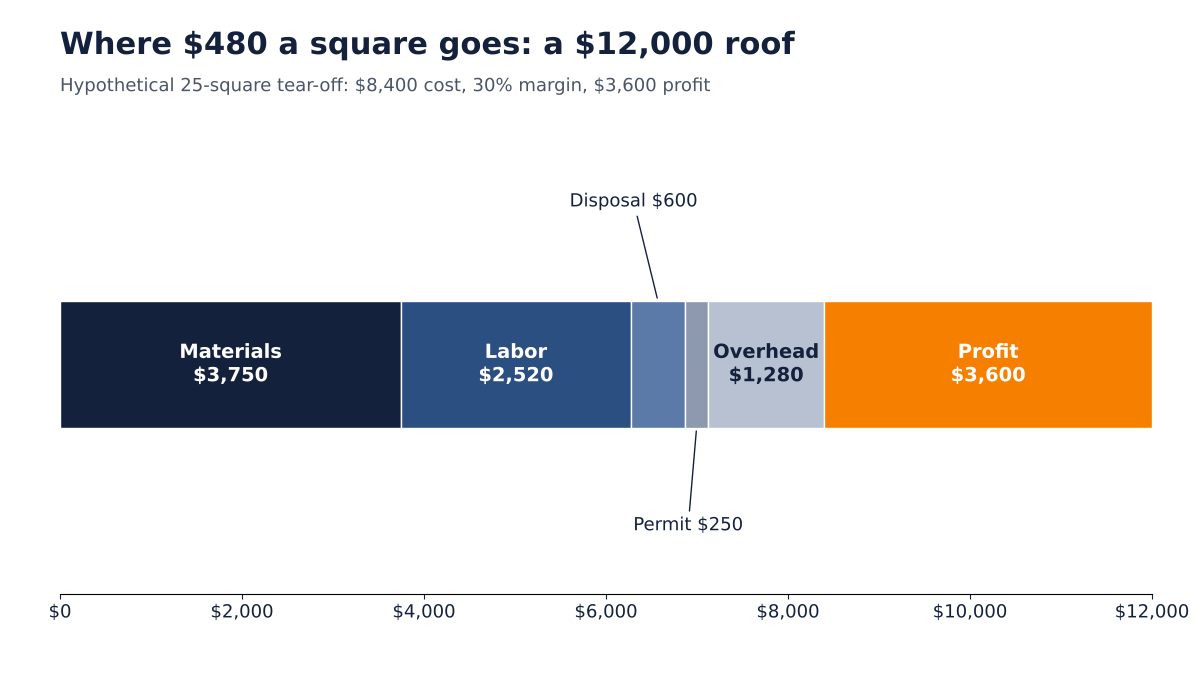
Hypothetical 25-square tear-off: $8,400 cost at a 30% margin = $12,000, or $480 a square. Knock $30 a square off and profit drops from $3,600 to $2,850. Worked below.
Why it matters: on a roof, the homeowner is buying trust as much as shingles. A clear inspection and a clear estimate win more jobs than a lower price, and they don't cost you margin.
Scope: US residential roofing contractors and owners who sell their own jobs. All dollar figures are hypothetical. For the money side, see roofing business profit margin. This isn't legal advice.
1. Inspect with the homeowner, not for them
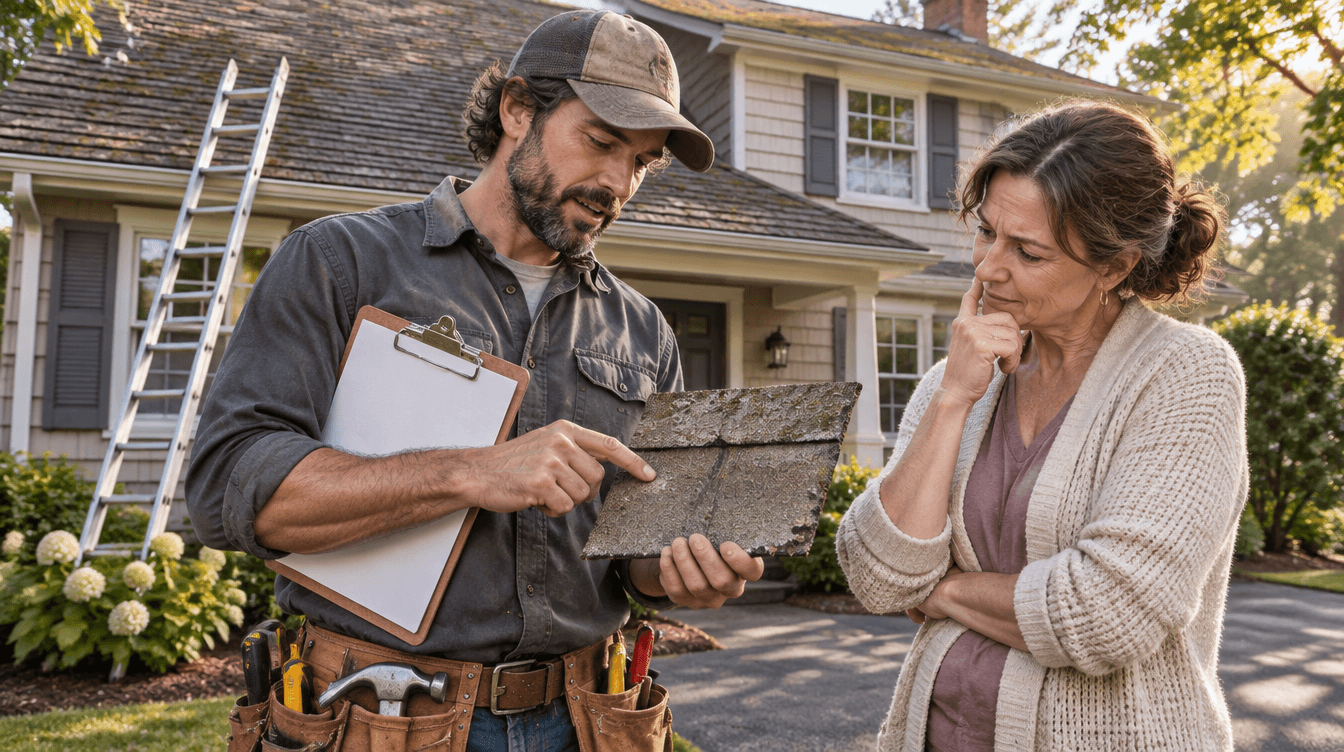
Get on the roof and bring the roof down to them. Photos of lifted tabs, granule loss, soft decking near the chimney or a cracked boot on a vent pipe do the selling for you.
Walk the homeowner through the pictures in the order you'd fix things. Name what's urgent, what can wait and what's fine. Saying "your north slope still has a few years" builds more trust than "the whole thing has to go."
Keep every photo with the job. You'll want them for the estimate, for an insurance adjuster and for the day someone asks why the decking line showed up on the invoice.
2. Write the scope line by line
"Replace roof, $12,000" loses to a competitor who explains what $12,000 buys. Spell it out:
- Tear-off: how many layers, and that the price changes if there's a second one you couldn't see.
- Decking: how many sheets are included, and a unit price for each extra sheet. For example, "includes up to 2 sheets of OSB, additional sheets $95 each installed" (hypothetical price).
- Underlayment, ice and water shield, drip edge, flashing and ventilation, named, not lumped.
- Shingle line and color, with the manufacturer warranty level.
- Cleanup and disposal: dumpster, magnet sweep for nails, gutters cleared.
- Your workmanship warranty, in years, separate from the manufacturer's.
The decking line is the one that saves arguments. Rotten decking is the classic surprise on a tear-off, and a unit price written in advance turns it into a line item instead of a fight. For the bigger picture on scope, see construction scope of work.
3. Give two or three options
Roofing is made for tiers. The roof is the same size whichever shingle the homeowner picks; the shingle line, underlayment and warranty change.
- Good: standard architectural shingle, synthetic underlayment, manufacturer's base warranty.
- Better: upgraded shingle line, ice and water shield in valleys and eaves, ridge vent, longer warranty.
- Best: premium or impact-rated shingle, full system accessories, the longest warranty you offer.
Build Better first, the roof you'd put on your own house. Price each option from its own cost at the same margin. The method is in good better best pricing.
4. Price per square from cost
Price per square is how homeowners compare roofers, so know where yours comes from. Hypothetical 25-square asphalt tear-off and reroof, one layer:
| Line | Cost |
|---|---|
| Materials: 25 squares at $150 (shingles, underlayment, drip edge, vents, nails) | $3,750 |
| Labor: 72 crew hours at $35/h | $2,520 |
| Dumpster and disposal | $600 |
| Permit | $250 |
| Overhead share for the job | $1,280 |
| Total cost | $8,400 |
| Price at 30% margin: $8,400 ÷ 0.70 | $12,000 |
| Price per square: $12,000 ÷ 25 | $480 |
| Profit | $3,600 |
The $35 labor rate starts from the national median wage for roofers, $26.65 an hour in 2025 (O*NET 47-2181), plus about 30% for payroll taxes, workers' comp and insurance. That load is an assumption, rounded up. Your workers' comp rate may be higher, so use your own number.
Paying a sales rep? Their commission is a cost of the job. Put it in before you apply the margin, or it comes out of your profit. Section 3 of the roofing margin guide shows how.
5. Hold your price
The homeowner has a cheaper bid at $450 a square. Matching it on the same roof means $11,250 instead of $12,000. Your cost is still $8,400, so profit drops from $3,600 to $2,850. That's $750, or about 21% of your profit, gone for the same work.
Before you match, compare scopes. The cheaper bid often skips ice and water shield, assumes no decking, reuses flashing or leaves out the permit. Walk the homeowner through the two estimates line by line. If they still want the lower number, offer your Good option instead of discounting Better.
Say the number with a straight face. Roofers who apologize for their price teach homeowners to haggle.
6. Handle insurance jobs carefully
Storm work is where sloppy paperwork bites. Write your estimate from the roof, not from the claim payout, and itemize it so it can be compared with the adjuster's scope. The contractor invoice for an insurance claim guide covers the format, and overhead and profit covers the O&P line.
Don't offer to "cover the deductible." The deductible is the homeowner's share under their policy, and absorbing it means your estimate overstates the real price of the job. Check your state's rules before you go anywhere near it.
7. Get the in-home paperwork right
A roof sold at the kitchen table comes with federal paperwork rules. The FTC's Cooling-Off Rule covers sales of $25 or more made at the buyer's home, including when the buyer invited you over (16 CFR 429.0).
For those sales, you must give the buyer a completed receipt or contract copy stating they may cancel "at any time prior to midnight of the third business day after the date of this transaction," plus a notice of cancellation form (16 CFR 429.1).
Door-knocking after a storm counts: you solicited the sale at the buyer's home. Put the cancellation statement and form in your contract, hold off on ordering materials or starting tear-off until the window closes (there's only a narrow emergency exception), and have a lawyer check your contract against your state's rules once.
8. Follow up and make yes easy
- Same day: text that the estimate is in their inbox, with the photos attached.
- Day 2 or 3: call and ask what questions came up, especially from whoever wasn't at the table.
- Day 7: one last note before the price expires. Shingle prices move; 30 days is plenty.
When they say yes, take the deposit then. With WinPal you can invoice from your phone and let clients pay online, and you can add a preview of the work to your estimate so the homeowner sees the new roof before they sign. Deposit and payment schedules are covered in contractor payment terms.
Then track your close rate: roofs sold ÷ roof estimates given, by month, with the denominator. Split retail and insurance jobs, because they close very differently.
Common roofing sales questions
How do you sell more roofing jobs?
Inspect with the homeowner and show photos, write a line-by-line scope with a decking unit price, give two or three shingle options priced from cost, send the estimate the same day and follow up within a few days. Track your close rate so you know which change worked.
What should a roofing sales pitch include?
What you found, with photos, what happens if they wait, what you'll install and why, the options and prices, your warranty, and what happens next. Keep it to the roof. Homeowners trust the roofer who explains the problem more than the one with the smoothest script.
Should I lower my price per square to win a roofing job?
Compare scopes first. A cheaper bid often leaves out underlayment upgrades, decking, flashing or the permit. If the scopes match and you still want the job, offer a lower-tier option. A $30 per square cut on a 25-square roof costs $750 of profit for the same work.
Does the 3-day cancellation rule apply to roofing?
Usually, for roofs sold at the homeowner's house. The FTC Cooling-Off Rule covers sales of $25 or more at the buyer's home, even when they invited you. Give the written cancellation statement and form, and check your state's rules, which can add more.
How do roofers follow up on estimates?
A same-day text with the estimate and photos, a call two or three days later to answer questions, and a final note before the price expires. Ask what came up rather than pushing for a decision. After three touches, record why you lost it.
What to do on your next roofing estimate
Photograph the roof, write the scope line by line with a decking unit price, build Good, Better and Best from cost with cost ÷ (1 − margin), and send it before you leave the driveway. Then put the follow-up dates in your calendar.
Selling HVAC systems too? See HVAC sales tips.
Already sent one? Upload it to the estimate checker and see if it's priced too low.