Handyman Business Plan: One-Page Example With Numbers
A one-page handyman business plan with real numbers: a $89,414.29 revenue target, about 9 jobs and 17 quotes a week, and a weekly number to check every Friday.
A handyman business plan can fit on one page: what you'll do and won't, who you work for, how they find you, your price, your yearly costs, the revenue that covers them, and how many jobs and quotes a week that takes. Write the numbers first. They tell you if the business pays you before you quit your job.
Revenue target = (your yearly pay + yearly overhead) ÷ (1 − margin).
Hypothetical: ($49,590 + $13,000) ÷ 0.70 = $89,414.29 a year. At 3 billable hours a job, that's about 9 jobs and 17 quotes a week. Worked below.
You don't need a 30-page plan with a market analysis of your county. You need one page that says how many jobs a week keep the lights on, and a habit of checking it.
Scope: US solo handymen starting out or in their first year. All figures are hypothetical and in US dollars; they reuse the numbers from our guide on how to start a handyman business, which covers licenses, insurance and taxes. This page is the plan.
1. Do you need a handyman business plan?
Not to open. You need one the day you ask a bank for money, and you'll want one the first slow week you wonder if this was a mistake.
The U.S. Small Business Administration describes two kinds. Traditional plans are long and detailed, and "Lenders and investors commonly request this plan." Lean plans summarize the essentials and "can take as little as one hour to make and are typically only one page" (SBA, Write your business plan).
If you're paying for tools from savings, write the one-page version. If you're borrowing, write it first anyway, then expand it.
2. The one-page handyman business plan (worked example)
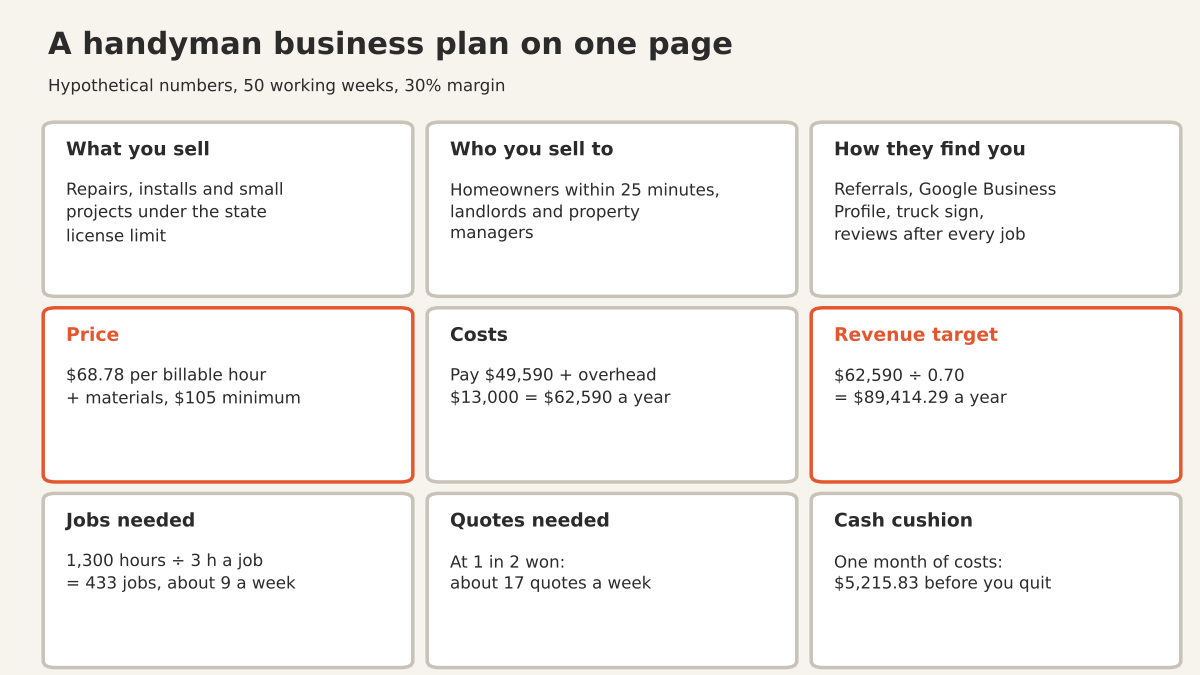
Nine boxes. Fill them in order, because each number feeds the next.
| Plan line | Hypothetical first year |
|---|---|
| What you sell | Repairs, installs and small projects under your state's license limit |
| Who you sell to | Homeowners within 25 minutes, landlords and property managers |
| How they find you | Referrals, Google Business Profile, truck sign, reviews after every job |
| Price | $68.78 per billable hour plus materials, $105 minimum |
| Yearly costs | Pay $49,590 + overhead $13,000 = $62,590 |
| Revenue target | $62,590 ÷ 0.70 = $89,414.29 |
| Jobs needed | 1,300 billable hours ÷ 3 hours a job = 433 jobs, about 9 a week |
| Quotes needed | At 1 in 2 quotes won, about 17 a week |
| Cash cushion | One month of costs: $5,215.83 |
3. What you'll do, and what you won't
List the services you can do well and quote fast. Then write the "won't" list: work that needs a licensed trade, jobs over your state's handyman limit, and anything you hate doing.
The handyman services list has 40 common services in eight groups, each with a pricing method. Pick 10 to 15 for the plan. The license limits by state are in the start guide; California and Florida are very different.
A short list also makes you faster. Quoting the same 12 jobs over and over is how you get a quote out before you leave the driveway.
4. Who you work for, and how they'll find you
Write two or three customer groups and how you reach each one. "Homeowners" is a start; "homeowners within 25 minutes" is a plan.
- Homeowners: most of your first-year work. Small jobs, often a list of them in one visit.
- Landlords and property managers: repeat work between tenants. They may want a certificate of insurance and steady pricing.
- Real estate agents: pre-sale and inspection repair lists with a deadline. Good for filling gaps, not for a whole year.
Channels go in the plan too: referrals from people who know you, a free Google Business Profile with your services and area, your name on the truck, and a review request the day each job is done.
5. Your price
The price line comes from your costs. Here's the short version from the start guide's hypothetical numbers:
- Pay: $49,590, the 2025 national median for general maintenance and repair workers on O*NET.
- Overhead: $13,000 a year for insurance, vehicle, tool replacement, phone and software, marketing, accounting and registration.
- Billable hours: 50 weeks × 40 hours × 65% billable = 1,300 hours.
- Cost per billable hour: $62,590 ÷ 1,300 = $48.15.
- Price: $48.15 ÷ (1 − 0.30) = $68.78 per billable hour at a 30% margin, plus materials.
Add a visit minimum so short jobs pay for the drive: 1.5 hours × $48.15 = $72.23, ÷ 0.70 = $103.19, rounded to $105. Run your own numbers in the hourly rate calculator, and see how to price handyman jobs for flat-rate pricing by task.
6. Revenue target, jobs and quotes per week
This is the part of the plan that changes how you work on Monday.
Revenue target: $62,590 ÷ 0.70 = $89,414.29 a year. That pays you, pays the overhead and leaves $26,824.29 for tools, a slow year and growth.
Jobs: if the average job is 3 billable hours, 1,300 ÷ 3 = 433 jobs a year. Over 50 weeks, that's about 9 jobs a week. A 3-hour job bills 3 × $68.78 = $206.34 in labor before materials.
Quotes: if you win 1 in 2 quotes, 433 jobs need about 867 quotes a year, or about 17 a week. That number surprises most people. It's why a fast, clean quote matters as much as good work: see how to write an itemized quote.
Your average job size and win rate will be different. Track both for a month and put your real numbers in. If your jobs average 2 hours, you need 13 jobs a week, not 9.
7. The weekly number
A yearly target is hard to feel. A weekly one isn't. Divide by 50 working weeks:
| Weekly line (hypothetical) | Amount |
|---|---|
| Your pay ($49,590 ÷ 50) | $991.80 |
| Overhead ($13,000 ÷ 50) | $260.00 |
| Profit ($26,824.29 ÷ 50) | $536.49 |
| Labor billed per week | $1,788.29 |
Materials come on top and go straight back out to the supply house, so leave them out of this number. Every Friday, add up the labor you billed. Under $1,788.29 means you're eating into profit first, then into your own pay.
8. Startup cash and the slow weeks
Handyman work runs all year, but it doesn't run evenly. Customers pay late, rain cancels exterior work, and January can be quiet.
Plan a cushion of one month of costs before you go full time: $62,590 ÷ 12 = $5,215.83 in the hypothetical plan. Add the tools you still need to buy. The start guide's overhead budget assumes you already own the basics.
Then protect the cushion: get a deposit when you buy materials, invoice the same day, and take cards so customers can pay on the spot. Contractor payment terms and how to invoice as a contractor cover both.
9. Check the plan every month
Once a month, compare four numbers with the plan: jobs done, average hours per job, quotes sent and won, and labor billed against $1,788.29 a week.
- Fewer quotes than planned? Work on leads: ask for referrals and reviews.
- Quotes out but not won? Look at speed and presentation before you cut the price.
- Enough jobs but short on money? Your jobs are smaller than planned or your price is too low.
Those numbers live in your estimates and invoices. WinPal is a mobile and web app for contractors and home-service pros that handles the paperwork around jobs: estimates, invoices, payments, jobs and schedules, customer info, expenses and reports. You can turn a photo and a voice note into a first-draft estimate and invoice from your phone so clients pay online. Plan costs are on the pricing page.
Common handyman business plan questions
What should be in a handyman business plan?
The services you'll offer and won't, your customer groups and how they find you, your price per hour and minimum, your yearly pay and overhead, a revenue target from cost ÷ (1 − margin), the jobs and quotes per week to reach it, and a cash cushion. For a loan, add projected financial statements.
How much revenue does a handyman business need?
Enough to cover your pay, your overhead and a margin. Add your target pay and yearly overhead, then divide by one minus your margin. In this guide's hypothetical plan, ($49,590 + $13,000) ÷ 0.70 = $89,414.29 in labor a year, before materials. Your number depends on your own costs.
How many jobs a week does a handyman need?
Divide your billable hours by your average job length, then by your working weeks. With 1,300 billable hours, 3-hour jobs and 50 weeks, that's about 9 jobs a week. At a 1 in 2 win rate, you'd send about 17 quotes a week to get them.
Can I get a loan with a one-page business plan?
Usually you'll need more. The SBA says lenders and investors commonly request the traditional plan, which is longer and more detailed. Start with the one-page version anyway: the numbers in it become the financial section of the long plan, and you'll know they hold up before a lender asks.
What to do this week
Fill in the nine boxes, starting with your yearly costs and revenue target. Then work out your jobs and quotes per week, and write your weekly number somewhere you'll see it every Friday.
Already sending quotes? Upload one to the estimate checker and see if it's priced too low. Doing yard work too? See the landscaping business plan.