Landscaping Business Plan: One-Page Example With Numbers
A one-page landscaping business plan with real numbers: a $78,733.33 revenue target, how many lawns it takes, and how much to save each month for winter.

A landscaping business plan can fit on one page: what you sell and where, who you sell to, how they find you, your prices, your yearly costs, the revenue that covers them, how many lawns that takes, and how you'll get through winter. The numbers section matters most, because it tells you if the business works before you buy the mower.
Revenue target = (your yearly pay + yearly overhead) ÷ (1 − margin).
Hypothetical: ($39,150 + $19,900) ÷ 0.75 = $78,733.33 a year. That's about 38 weekly lawns, or 30 lawns plus cleanups and mulch. Worked below.
Most sample plans online run 20 or 30 pages and were written for a bank. If you're borrowing, you'll need one of those. If you're not, a one-page plan you actually look at every month beats a long one in a drawer.
Scope: US solo lawn care and landscaping operators, first or second season. All figures are hypothetical and in US dollars; they reuse the numbers from our guide on how to start a landscaping business, which covers licenses, insurance and taxes. This page is the plan.
1. What a landscaping business plan needs (and what it can skip)
It needs enough to answer one question: will the season pay for the year? Everything else is optional until a lender asks.
The U.S. Small Business Administration splits plans into two types. Traditional plans are the long ones; the SBA notes that "Lenders and investors commonly request this plan." Lean plans summarize the key points, and the SBA says they "can take as little as one hour to make and are typically only one page" (SBA, Write your business plan).
For a solo landscaper, the one-page version covers nine lines. The next section fills them in.
2. The one-page landscaping business plan (worked example)
Here's a filled-in plan for a hypothetical first-year lawn care and landscaping business. Swap in your own numbers line by line.
| Plan line | Hypothetical first year |
|---|---|
| What you sell | Weekly mowing, spring and fall cleanups, mulch and bed work |
| Where | Neighborhoods within 15 minutes of home, tightest routes first |
| Who you sell to | Homeowners with weekly lawns; a few small HOAs later |
| How they find you | Referrals, door hangers near current stops, Google Business Profile |
| Price | About $58 per weekly mow; $69.43 per billable hour plus materials on projects |
| Yearly costs | Owner pay $39,150 + overhead $19,900 = $59,050 |
| Revenue target | $59,050 ÷ 0.75 = $78,733.33 |
| Customers needed | 30 weekly lawns + 234 hours of cleanups and projects |
| Winter plan | Set aside $2,460.42 a month, March to October |
That's the whole plan. The sections below show where each number comes from.
3. Services and service area
Write down what you'll sell this season and what you won't. The "won't" list saves you from quoting a retaining wall you can't build legally or profitably.
Start with services that share equipment and a schedule: mowing, edging, blowing, cleanups, mulch. Add projects once your mowing customers ask. The landscaping services list sorts 35 services by how you price them, so you can pick your starter menu.
Then draw your service area. In lawn care, drive time is unpaid time. A plan that says "15 minutes from home" keeps you from saying yes to a lawn 40 minutes away that costs more than it pays.
4. Customers, and how they'll find you
Name who you're selling to, then how each one hears about you. "Everyone with a yard" isn't a customer segment.
- Weekly homeowners: the base of the plan. Recurring, predictable, priced per visit.
- Project customers: mostly your mowing customers in spring and fall. Bigger tickets, deposits on materials.
- Small commercial and HOAs: a later step. They often want insurance certificates and bid on price; see how to price commercial lawn care before you chase them.
For channels, write the three you'll actually do: ask every customer for a neighbor's name, door-hang the streets around every stop, keep your Google Business Profile current. A new lawn next door to one you already mow costs almost no drive time.
5. Prices from your own costs
Your price line comes from what one billable hour costs the business, not from the cheapest flyer in the neighborhood.
- Your pay: $39,150, the 2025 national median for landscaping and groundskeeping workers on O*NET. Treat it as a floor.
- Overhead: $19,900 a year for insurance, truck, equipment payback, fuel and repairs, phone and software, marketing, accounting and registration (line by line in the start guide).
- Billable hours: 36 weeks × 45 hours × 70% billable = 1,134 hours.
- Cost per billable hour: $59,050 ÷ 1,134 = $52.07.
- Price: $52.07 ÷ (1 − 0.25) = $69.43 per billable hour at a 25% margin.
A weekly mow that takes 50 minutes including drive and loading costs $52.07 × 50 ÷ 60 = $43.39. Divide by 0.75 and you get about $58 a visit. Check your own numbers with the hourly rate calculator and single lawns with the lawn care pricing calculator.
6. Revenue target, and how many lawns it takes
The revenue target is the plan's most important line. It turns "I want to make a living" into a number of customers.
Revenue target: $59,050 ÷ 0.75 = $78,733.33. That covers your pay, your overhead and leaves $19,683.33 of profit for equipment, slow years and growth.
Mowing only: one weekly lawn at $58 for 36 weeks brings in $2,088. $78,733.33 ÷ $2,088 = 37.7, so 38 weekly lawns. That's about 32 hours of mowing a week, all of your billable time (1,134 ÷ 36 = 31.5 hours a week). No room for a single cleanup.
A mix: 30 weekly lawns bring in 30 × $2,088 = $62,640 and use 900 of your 1,134 billable hours. The other 234 hours of cleanups, mulch and bed work at $69.43 an hour bring in $16,246.62, plus materials. Total: $78,886.62, just over the target.
The mix is the better plan. Project work pays the same hourly rate, fills rain-delay gaps and turns into next year's referrals. Price projects line by line with how to price landscaping jobs, and see per-visit benchmarks in the lawn care pricing chart.
7. The winter cash plan
This is the line most landscaping plans skip, and the one that sinks first-year businesses. Your costs run 12 months. Your revenue mostly doesn't.
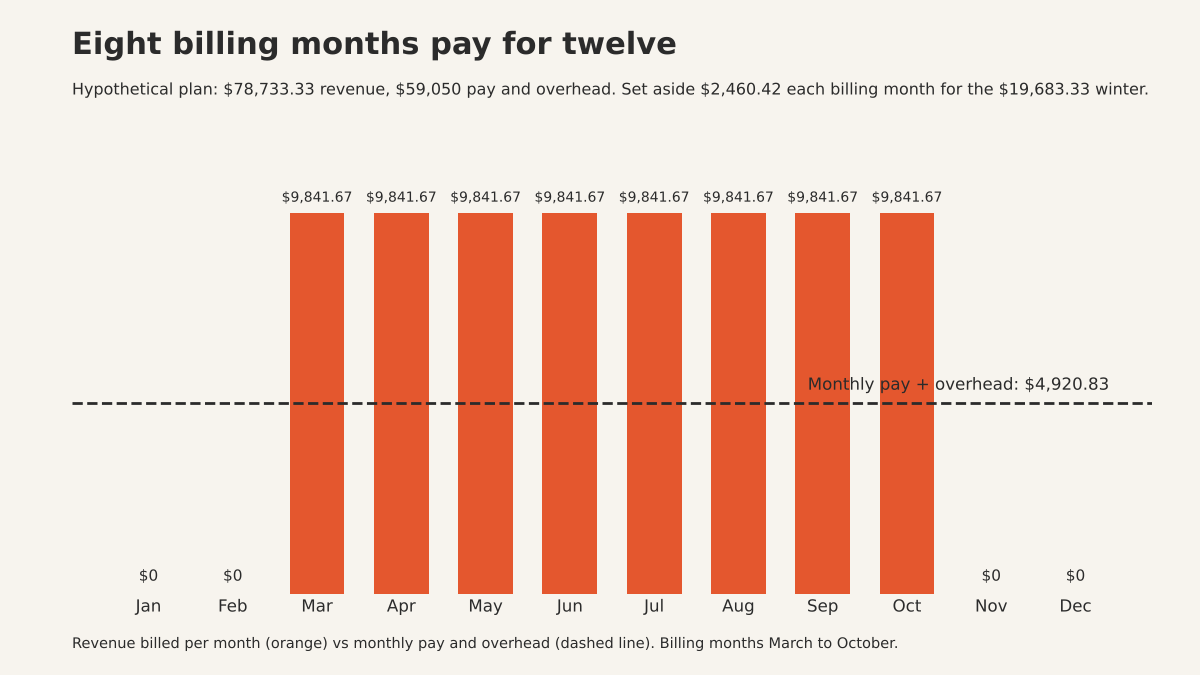
In the hypothetical plan, pay and overhead come to $59,050 ÷ 12 = $4,920.83 a month. If you bill March to October, revenue averages $78,733.33 ÷ 8 = $9,841.67 a month in season and roughly nothing in the other four.
The four winter months need 4 × $4,920.83 = $19,683.33. Spread over eight billing months, that's $2,460.42 a month into a separate winter account, every month, starting in March. July feels rich. It isn't.
Two ways to shrink that number: add winter work like snow plowing or holiday light installs, or offer yearly maintenance contracts billed in equal monthly payments. For the timing side of cash, see construction cash flow.
8. Startup money, and where it comes from
List what you need before the first invoice gets paid, then where that money comes from.
- Equipment: the start guide's hypothetical kit (commercial mower, trimmer, edger, blower, trailer, spreader, hand tools) is $15,000.
- Two months of overhead: $19,900 ÷ 12 × 2 = $3,316.67, because March invoices get paid in April.
- Total: $18,316.67 in this example.
Write the source next to it: savings, equipment financing, a loan. If it's a loan, the lender will likely want the long version with financial statements, which is where the SBA's traditional plan format comes in. Buying used equipment is the fastest way to shrink the first line.
Get deposits on project materials so customers fund their own mulch, not you. Contractor payment terms covers how much your state lets you take.
9. Keep the plan alive: check it monthly
A plan is only useful if you compare it with what happened. Once a month, check four numbers against the plan:
- Weekly lawns signed vs 30.
- Project hours billed vs 234 for the year.
- Revenue billed vs $9,841.67 for the month.
- Winter account balance vs $2,460.42 times months billed.
Behind on lawns in May? Door-hang harder or raise the project mix. Ahead? Look at your price before you look at a second mower.
The numbers come from your estimates and invoices, so keep those in one place. WinPal is a mobile and web app for contractors and home-service pros that handles the paperwork around jobs: estimates, invoices, payments, jobs and schedules, customer info, expenses and reports. You can turn a photo and a voice note into a first-draft estimate and invoice from your phone so clients pay online. See how it fits a landscaping business.
Common landscaping business plan questions
Do I need a business plan to start a lawn care business?
Not legally. You need one when you borrow money, and lenders usually want the long version. But a one-page plan with a revenue target, a customer count and a winter cash plan is worth an evening before you buy equipment, because it shows whether your prices and your season can carry a full year.
How long should a landscaping business plan be?
One page if it's for you, longer if it's for a lender. The SBA describes lean plans as typically one page and traditional plans as the format lenders and investors commonly request. Start with the one page; you can expand it into a traditional plan later without changing the numbers.
How many customers does a lawn care business need?
Divide your revenue target by what one customer pays you per season. In this guide's hypothetical plan, $78,733.33 ÷ $2,088 a season means about 38 weekly lawns for a mowing-only business, or 30 lawns plus 234 hours of cleanups and project work. Your numbers will differ with your price and season length.
What goes in the financial section of a landscaping business plan?
Your yearly pay and overhead, your price per hour and per visit, a revenue target from cost ÷ (1 − margin), the customers needed to reach it, a month-by-month cash plan for the off-season, and your startup money with its source. A lender will also ask for projected income and cash flow statements.
What to do this week
Write your nine lines. Start with yearly costs and the revenue target, then work out how many lawns that takes and how much goes into the winter account each month. If the numbers don't work on paper, they won't work in July.
Already quoting jobs? Upload an estimate to the estimate checker and see if it's priced too low. Running a handyman business on the side? See the handyman business plan.